
Psilocybin vs Traditional Nootropics: Mood and Focus Impact
Feeling stuck between conventional nootropics and the search for real anxiety relief is a familiar challenge for many Canadian adults navigating mental wellness. With traditional cognitive enhancers focused mainly on short-term focus or memory support, curiosity is growing around safer, more holistic options. This article unpacks the core differences between psilocybin and nootropics and explores how evolving science is shaping safer strategies for anxiety reduction and enhanced daily focus.
Table of Contents
- Defining Psilocybin and Nootropics Today
- Core Differences in Mechanisms and Effects
- Risks, Limitations, and Safety Guidelines
- Legal Status in Canada and Worldwide
- Choosing the Best Option for Mental Wellness
Key Takeaways
| Point | Details |
|---|---|
| Difference in Mechanisms | Psilocybin promotes long-term neuroplasticity and emotional processing, while traditional nootropics focus on short-term cognitive performance. |
| Safety Considerations | Psilocybin requires careful psychological evaluation and professional supervision, unlike traditional nootropics which typically have established safety profiles. |
| Legal Landscape | Psilocybin’s legal status is complex and varies by region, necessitating understanding of local regulations before use. |
| Personalized Strategy | Choosing between psilocybin and nootropics should consider individual health history, treatment goals, and risk tolerance for mental wellness. |
Defining Psilocybin and Nootropics Today
Psilocybin represents a fascinating frontier in mental wellness research, emerging as a potentially transformative compound that challenges traditional approaches to cognitive enhancement and mood regulation. Unlike conventional nootropics, psilocybin offers a unique neurochemical pathway that goes beyond simple cognitive optimization.
At its core, psilocybin is a naturally occurring psychedelic compound found in specific mushroom species, primarily within the Psilocybe genus. Cutting-edge neuroscience research suggests it possesses remarkable potential for treating complex psychiatric conditions, distinguishing itself from traditional cognitive enhancers.
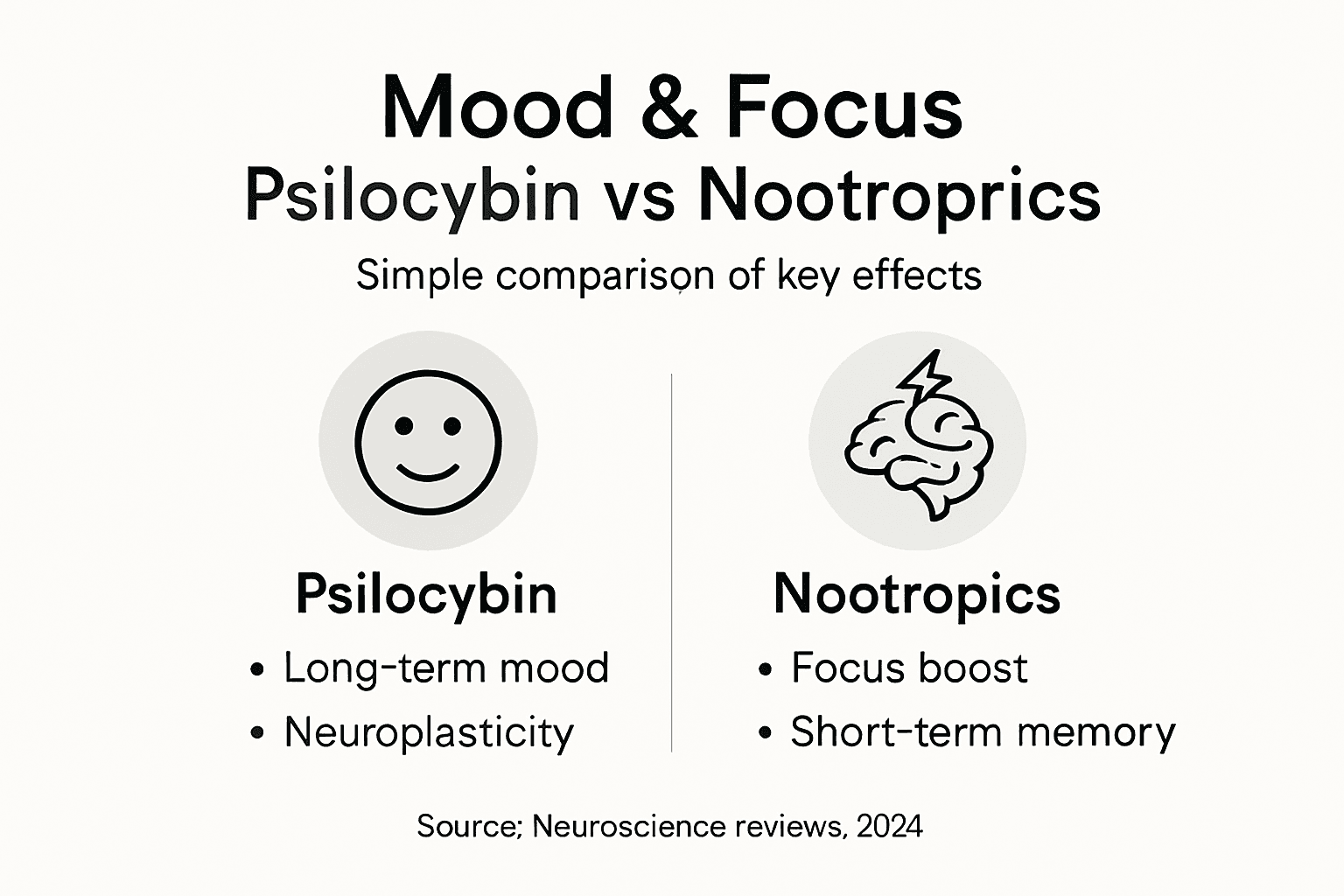
Traditional nootropics and psilocybin differ fundamentally in their mechanisms of action:
- Nootropics: Primarily focused on immediate cognitive performance
- Psilocybin: Targets deeper neuroplastic and emotional processing mechanisms
- Cognitive Enhancement: Nootropics aim for short-term improvements
- Neurological Impact: Psilocybin promotes long-term synaptic growth and neuronal connections
The neurological landscape of psilocybin reveals fascinating characteristics that set it apart from standard cognitive enhancers. Frontier research in neuroscience highlights its potential for neuroprotection and sustained neuroplastic effects, suggesting a more holistic approach to mental wellness.
Pro tip: When exploring cognitive enhancement options, consider consulting healthcare professionals who understand the nuanced differences between traditional nootropics and emerging psychedelic compounds like psilocybin.
Core Differences in Mechanisms and Effects
Psilocybin and traditional nootropics represent fundamentally different approaches to cognitive and emotional enhancement, with their mechanisms of action revealing profound neurological distinctions. While both aim to improve mental performance, their pathways and impacts diverge significantly in neural interaction and therapeutic potential.

Neurochemical research demonstrates that psilocybin operates through unique receptor interactions, specifically acting as a partial agonist at serotonin 5-HT2A receptors. This mechanism triggers altered brain connectivity and emotional modulation, creating a fundamentally different experience from standard cognitive enhancers.
Key neurological differences include:
- Receptor Interaction: Psilocybin targets serotonin 5-HT2A receptors
- Cognitive Impact: Nootropics enhance specific cognitive functions
- Emotional Processing: Psilocybin enables deeper emotional exploration
- Neuroplasticity: Psilocybin promotes long-term neural restructuring
Neuropsychiatric investigations highlight that traditional nootropics primarily enhance attention and memory through neurotransmitter systems like acetylcholine and dopamine. In contrast, psilocybin induces profound consciousness shifts, potentially offering more comprehensive mood regulation and therapeutic benefits.
Here is a summary of core differences between psilocybin and traditional nootropics:
| Aspect | Psilocybin | Traditional Nootropics |
|---|---|---|
| Primary Effect | Emotional exploration and neuroplasticity | Short-term memory and focus boost |
| Administration Needs | Requires supervised setting | Often suitable for routine use |
| Onset of Impact | Hours to days, with lasting changes | Immediate to short-term, reversible |
| Suitability | Best for clinical intervention | Suitable for daily cognitive support |
Pro tip: Consider consulting neuroscience professionals to understand how individual neurochemistry might interact with different cognitive enhancement approaches.
Risks, Limitations, and Safety Guidelines
Psilocybin and traditional nootropics each present unique safety considerations that demand careful evaluation before incorporation into mental wellness strategies. Understanding these nuanced risks is crucial for responsible and informed decision-making about cognitive enhancement approaches.
Clinical safety research emphasizes that while psilocybin shows promising therapeutic potential, it requires controlled clinical settings due to potential psychological risks. These risks include:
- Acute Psychological Reactions: Potential anxiety and paranoia
- Individual Variability: Unpredictable psychological responses
- Contraindications: Higher risks for individuals with psychiatric histories
- Setting Dependency: Requires supervised, professional administration
Psychological assessment protocols highlight critical screening criteria for psilocybin therapy. Clinicians recommend comprehensive evaluations that consider personal and familial psychiatric background, ensuring safe and appropriate use. Traditional nootropics, by contrast, typically involve more standardized monitoring for tolerance and potential physiological interactions.
Key safety considerations demand a nuanced approach. While traditional nootropics often have more established safety profiles, psilocybin requires significantly more personalized risk assessment and professional guidance. Professional medical consultation remains the most critical step in determining individual suitability.
Pro tip: Always consult a healthcare professional and undergo comprehensive psychological screening before exploring any cognitive enhancement strategy.
Legal Status in Canada and Worldwide
Psilocybin exists in a complex legal landscape that varies dramatically across different jurisdictions, creating a nuanced regulatory environment for potential users and researchers. Understanding these legal distinctions is crucial for anyone considering its therapeutic or cognitive enhancement potential.
Canadian legal frameworks classify psilocybin as a Schedule III controlled substance, with emerging pathways for medical and research exemptions. Key legal characteristics include:
- Medical Exemptions: Increasingly available under strict supervision
- Research Access: Limited but expanding legal permissions
- Therapeutic Use: Growing regulatory flexibility
- Recreational Status: Remains prohibited nationwide
International regulatory trends reveal a dynamic global perspective on psilocybin. While some countries maintain strict prohibitions, others are gradually developing more progressive regulatory approaches, particularly for medical and therapeutic applications.
Traditional nootropics typically face fewer legal challenges, operating within established pharmaceutical and dietary supplement regulations. This contrasts sharply with psilocybin’s more complex legal status, which requires careful navigation of regional and national legal frameworks.
Use this reference table to quickly compare legal considerations:
| Region | Psilocybin Legal Status | Nootropics Legal Status |
|---|---|---|
| Canada | Schedule III; medical and research exemptions possible | Permitted as supplements or pharmaceuticals |
| United States | Mostly illegal; some local decriminalization | Regulated, many available over the counter |
| Europe | Mostly prohibited; medical research in progress | Widely available, varying restrictions |
| Global Trend | Gradual medical acceptance | Stable regulatory environment |
Pro tip: Consult local legal and medical professionals to understand the specific regulatory requirements in your jurisdiction before exploring psilocybin-based treatments.
Choosing the Best Option for Mental Wellness
Selecting the most appropriate cognitive enhancement strategy requires careful consideration of individual health goals, risk tolerance, and personal circumstances. Mental wellness is not a one-size-fits-all approach, demanding nuanced evaluation of available options.
Mental wellness research highlights critical factors for choosing between psilocybin and traditional nootropics:
- Individual Health History: Critically assess personal medical background
- Treatment Goals: Define specific mental performance objectives
- Risk Tolerance: Evaluate psychological and legal risk levels
- Accessibility: Consider legal and medical supervision requirements
Key comparative factors emerge when examining potential mental wellness approaches. Traditional nootropics offer predictable, low-risk cognitive support, while psilocybin presents potential for more profound psychological transformation under clinical guidance.
Clinical integration strategies emphasize the importance of personalized approaches. Integrating professional medical guidance helps navigate the complex landscape of cognitive enhancement, ensuring both safety and effectiveness.
Pro tip: Develop a comprehensive consultation strategy with healthcare professionals who understand both traditional nootropics and emerging psychedelic therapeutic approaches.
Discover Safe and Effective Cognitive Enhancement with Microdose Psilocybin
Struggling to find the right balance between mood improvement and focus enhancement is a common challenge addressed in the comparison between psilocybin and traditional nootropics. Many people seek natural solutions that go beyond short-term memory boosts to achieve lasting emotional well-being and mental clarity. At Fungal Friend, we understand these goals and offer carefully crafted microdose psilocybin products designed to support anxiety reduction, improve focus, and promote mood balance through natural neuroplastic benefits.
Explore our curated selection including mushroom capsules, infused teas, and magic mushroom chocolates all tailored for both newcomers and experienced users. Whether you want a gentle daily boost or a deeper psychedelic experience under safe conditions, Fungal Friend is your trusted Canadian source. Take the next step toward mindful cognitive enhancement today by visiting our Uncategorized Archives – Fungal Friend and learn more about the nuances of psilocybin versus traditional nootropics. Start your journey safely with expert guidance and discreet shipping by visiting https://fungalfriend.co now.
Frequently Asked Questions
What is psilocybin and how does it differ from traditional nootropics?
Psilocybin is a naturally occurring psychedelic compound found in certain mushrooms, particularly within the Psilocybe genus. Unlike traditional nootropics that focus on immediate cognitive performance, psilocybin works through different neurochemical pathways, promoting deeper emotional processing and long-term neuroplasticity.
How do the effects of psilocybin and traditional nootropics compare in terms of cognitive enhancement?
Traditional nootropics primarily enhance short-term cognitive functions, such as memory and focus, while psilocybin can support profound emotional exploration and may lead to lasting changes in mental wellness through neuroplastic effects.
What are the safety considerations when using psilocybin compared to traditional nootropics?
While traditional nootropics generally have established safety profiles, psilocybin requires more personalized risk assessments due to potential psychological risks like anxiety or paranoia. It is advisable to seek professional guidance before using psilocybin.
Are there legal restrictions on psilocybin compared to traditional nootropics?
Yes, psilocybin is classified as a Schedule III controlled substance in many jurisdictions, which restricts its use and research. Traditional nootropics typically face fewer legal challenges and are more readily available for use.