
Microdosing Workflow for Focus: Achieve Daily Clarity
Balancing demanding work routines with mental clarity can feel like a constant struggle for many Canadian professionals. Microdosing psilocybin offers a promising path, but success depends on more than just the substance itself. By focusing on psychological readiness and clear intention setting, you can approach microdosing as a purposeful strategy for improving focus and productivity. This guide outlines practical steps to help you assess your readiness, select quality products, and track results for safe and sustainable workflow enhancement.
Table of Contents
- Step 1: Assess Your Readiness and Set Clear Focus Goals
- Step 2: Select Quality Microdose Products and Establish Dosage
- Step 3: Schedule Your Microdosing Workflow for Seamless Integration
- Step 4: Track Focus Levels and Adjust Based on Results
- Step 5: Evaluate Workflow Success and Refine Your Approach
Quick Summary
| Main Insight | Explanation |
|---|---|
| 1. Assess Mental Readiness | Evaluate your current mental state to determine your suitability for microdosing. Focus on stress levels and motivation. |
| 2. Choose Quality Microdose Products | Select reputable microdose substances with purity and consistent potency to maximize benefits. |
| 3. Schedule Consistently | Establish a structured microdosing schedule to enhance cognitive performance while allowing for rest periods. |
| 4. Track Your Progress | Implement a systematic tracking method to monitor focus levels and make data-informed adjustments. |
| 5. Regularly Evaluate Outcomes | Conduct periodic reviews to reflect on progress, refining your approach based on achieved goals and experiences. |
Step 1: Assess Your Readiness and Set Clear Focus Goals
Successfully integrating microdosing into your workflow requires strategic preparation and honest self-assessment. This step will help you define precise mental clarity objectives and evaluate your personal readiness for a microdosing practice.
Begin by conducting a thorough self-evaluation of your current mental state and professional goals. Research on microdosing psychological preparation emphasizes the critical role of psychological readiness in achieving optimal results. Consider the following assessment dimensions:
- Current stress levels
- Mental health and emotional stability
- Professional performance challenges
- Personal motivation and discipline
- Existing medical conditions or medications
Your assessment should create a holistic snapshot of your mental landscape. Intention setting for microdosing plays a pivotal role in determining potential outcomes. Develop specific, measurable goals that align with your focus enhancement objectives.
Clear intentions transform microdosing from a random experiment into a purposeful mental performance strategy.
Establish concrete, time-bound goals such as improving work concentration, reducing anxiety during presentations, or enhancing creative problem-solving skills. These precise targets will serve as your psychological compass throughout the microdosing journey.
Pro tip: Document your baseline mental state through journaling, tracking productivity metrics, and recording subjective emotional experiences before beginning your microdosing protocol.
Step 2: Select Quality Microdose Products and Establish Dosage
Choosing the right microdose product and determining your optimal dosage is crucial for achieving mental clarity and focus. This step will guide you through selecting high-quality microdose substances and establishing a personalized dosing strategy that aligns with your specific wellness objectives.
Start by researching reputable sources that provide comprehensive microdosing guidance. Your product selection should prioritize several key considerations:
- Product purity and source
- Third-party lab testing results
- Consistent potency and concentration
- Recommended strain characteristics
- Compatibility with your health profile
Understand that microdosing is not a one-size-fits-all approach. Individual sensitivity plays a significant role in determining the appropriate dosage. Most practitioners recommend starting with a low initial dose and gradually adjusting based on your body’s response.
The key to successful microdosing is finding your personal threshold – not too little, not too much.
Typical microdose ranges vary between 0.1-0.3 grams for dried mushrooms, but this can differ based on individual metabolism, body weight, and personal neurochemistry. Implement a careful titration process where you incrementally adjust your dose while monitoring your cognitive performance and overall well-being.
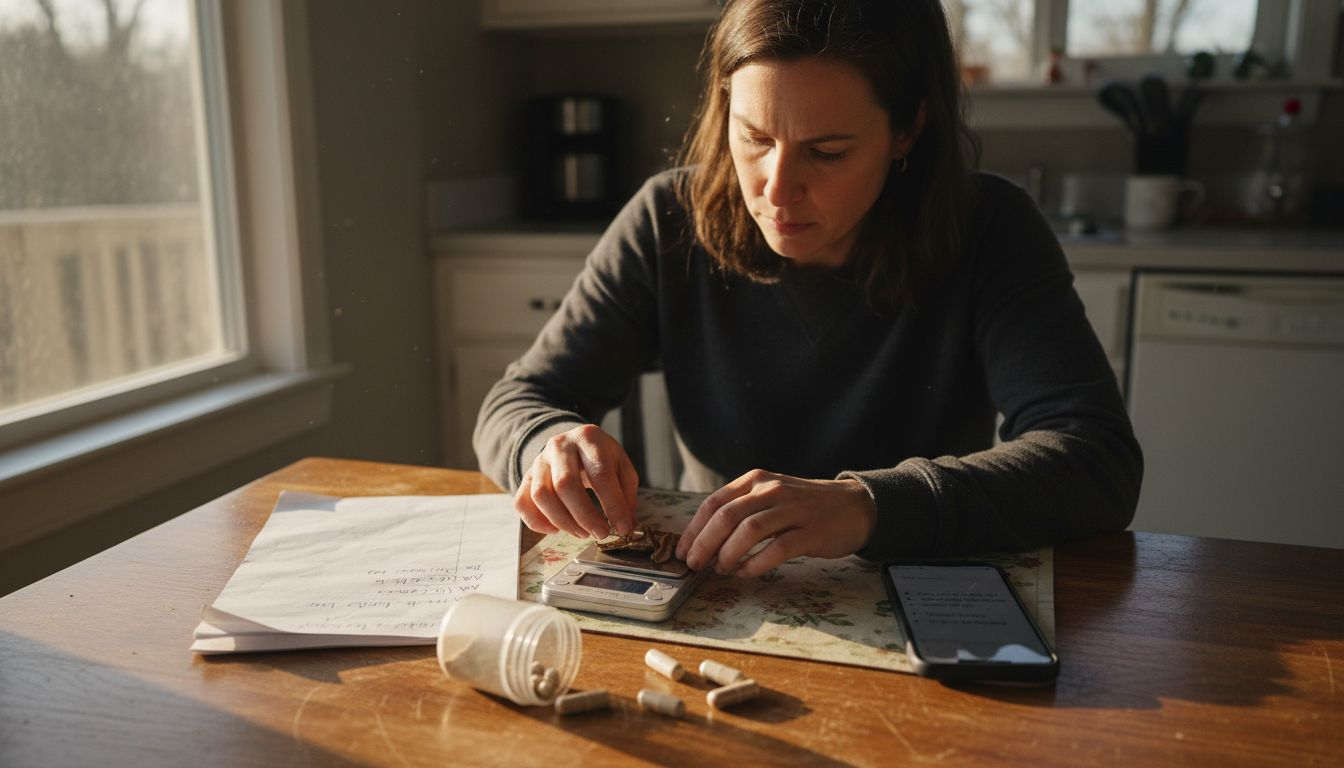
Pro tip: Maintain a detailed microdosing journal to track your dosage, subjective experiences, and any changes in mental clarity, productivity, and emotional state.
Step 3: Schedule Your Microdosing Workflow for Seamless Integration
Creating a structured and intentional microdosing workflow is essential for maximizing cognitive benefits and maintaining consistent progress. This step will help you design a personalized scheduling approach that integrates microdosing seamlessly into your daily routine while preserving your overall well-being.
Designing an effective microdosing schedule requires strategic planning and self-awareness. Psilocybin dosage workflow strategies recommend establishing a consistent rhythm that aligns with your professional and personal commitments. Consider implementing the following scheduling framework:
- Consistent dosing days
- Strategic rest periods
- Performance tracking intervals
- Morning vs. afternoon timing considerations
- Work and personal life synchronization
Most microdosing practitioners follow the Fadiman Protocol, which involves a structured approach of dosing one day, followed by two rest days. This method helps prevent tolerance buildup and allows for careful observation of subtle cognitive shifts.
Microdosing is a nuanced practice – your schedule should be flexible yet disciplined.
Begin by selecting specific days of the week for microdosing that minimize potential disruptions to your workflow. Typically, mid-week days provide the most stable environment for tracking your cognitive response and maintaining professional performance.
Pro tip: Synchronize your microdosing schedule with your most demanding cognitive tasks, using your peak performance windows strategically to maximize mental clarity and focus.
Here is a quick comparison of common microdosing scheduling protocols:
| Protocol Name | Dosing Pattern | Main Advantage | Consideration |
|---|---|---|---|
| Fadiman Protocol | 1 day on, 2 days off | Reduces tolerance, simple tracking | May not suit all routines |
| Every Other Day | Alternate days dosing | More frequent feedback, flexible | Faster tolerance possible |
| Weekend Only | Dose on weekends | Minimizes work interference | Slower measurable progress |
| Intuitive Approach | Unscheduled, as needed | Personalized, adaptable | Harder to assess outcomes |
Step 4: Track Focus Levels and Adjust Based on Results
Measuring and analyzing your cognitive performance during microdosing is crucial for optimizing your mental clarity and personal growth. This step will empower you to develop a systematic approach to tracking your focus levels and making informed adjustments to your microdosing protocol.
Comprehensive microdosing tracking tools recommend creating a structured framework for monitoring your mental performance and subjective experiences. Develop a tracking system that captures multiple dimensions of your cognitive and emotional state:
- Daily focus intensity
- Productivity metrics
- Mood and emotional stability
- Energy levels
- Creativity and problem-solving capacity
- Stress response
The quantified self-approach involves detailed documentation of your microdosing journey. Most successful practitioners use a combination of quantitative scoring and qualitative journaling to capture nuanced changes in mental performance.
Your tracking system is your personal laboratory – precision matters more than perfection.
Implement a consistent scoring method where you rate each tracked metric on a scale of 1-10, allowing you to detect subtle shifts in your cognitive landscape. Systematic monitoring techniques emphasize the importance of objective measurement and regular reflection.
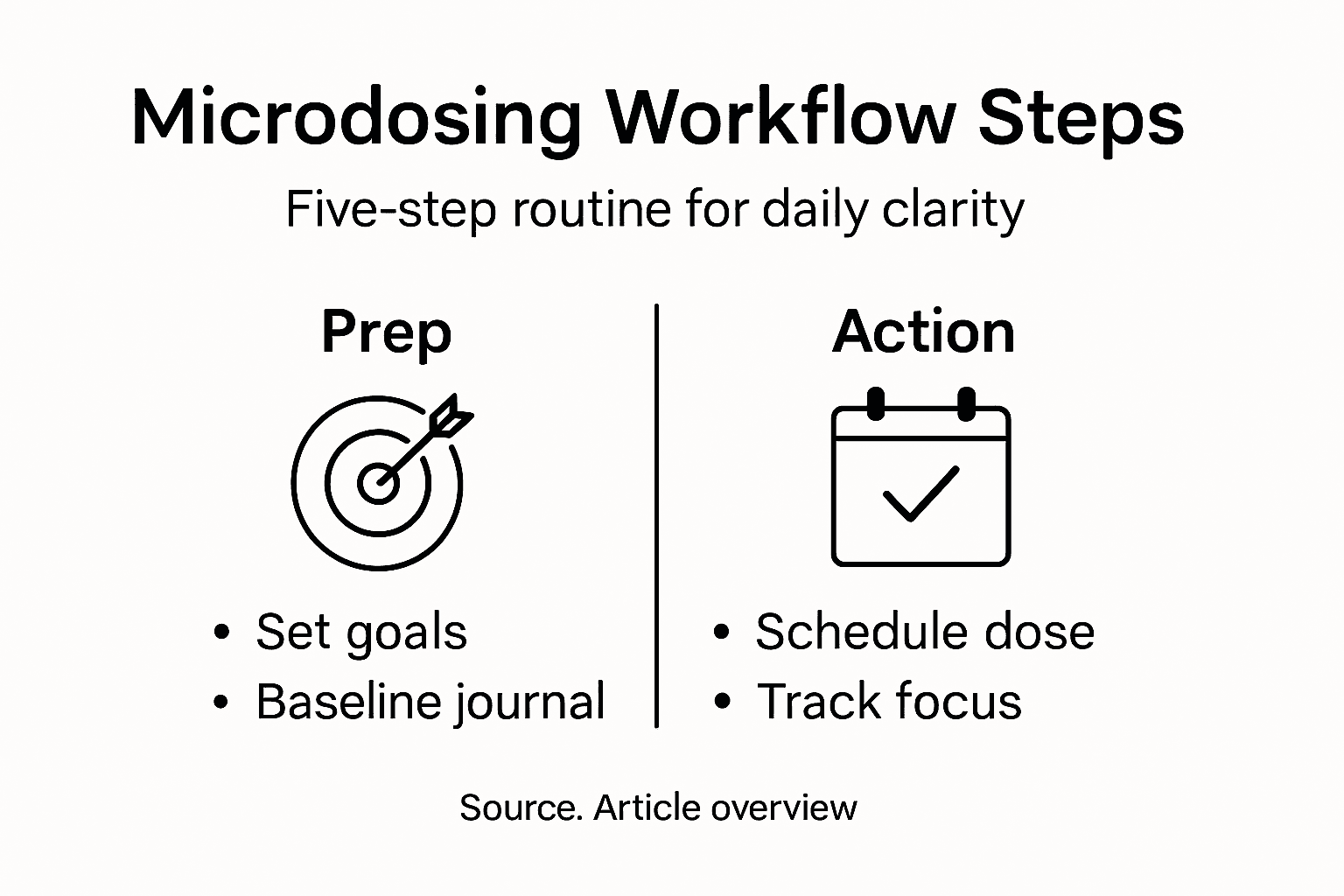
Pro tip: Use a dedicated digital or physical journal with predefined tracking categories to ensure consistent and comprehensive data collection about your microdosing experience.
Step 5: Evaluate Workflow Success and Refine Your Approach
Transforming your microdosing practice into a sustainable, high-performance workflow requires consistent reflection and strategic refinement. This step will guide you through a comprehensive evaluation process that ensures continuous improvement and personal optimization.
Methodical microdosing evaluation techniques emphasize the importance of holistic assessment beyond simple data tracking. Develop a multi-dimensional review process that examines your microdosing journey from several critical perspectives:
- Cognitive performance metrics
- Emotional and psychological shifts
- Professional productivity changes
- Physical energy and wellness indicators
- Long-term personal growth objectives
- Alignment with initial intentions
The iterative refinement process involves comparing your actual outcomes with your original goals. Most successful practitioners approach this evaluation with curiosity and openness, understanding that microdosing is a dynamic, personalized experience.
Refinement is not about perfection – it’s about progressive, intentional improvement.
Implement quarterly reviews where you deeply analyze your tracking data, systematic reflection exercises can help you identify patterns, breakthrough moments, and areas requiring adjustment. Be prepared to modify your dosage, scheduling, or overall approach based on these insights.
Pro tip: Schedule your evaluation sessions in advance and treat them as non-negotiable professional development appointments, ensuring consistent and objective self-assessment.
The following table summarizes the key areas to evaluate during your periodic workflow review:
| Review Dimension | Example Assessment Focus | What to Refine |
|---|---|---|
| Cognitive Performance | Attention during meetings | Adjust dosing schedule |
| Emotional Well-being | Emotional resilience, stress | Update intention setting |
| Professional Productivity | Project completion rate | Optimize workflow timing |
| Alignment With Intentions | Goal progress, personal meaning | Rethink desired outcomes |
| Physical Wellness | Energy, sleep quality | Monitor health parameters |
Unlock Your Best Focus with a Trusted Microdosing Partner
Microdosing for enhanced daily clarity requires more than just intention and tracking. The challenge lies in choosing the right quality products and creating a consistent, personalized workflow that supports your mental clarity goals. If you’re seeking reliable microdose psilocybin options that align with your focus enhancement journey, Fungal Friend offers a carefully curated selection designed to meet your needs. From mushroom capsules to infused teas, every product prioritizes purity and potency tailored for your success.
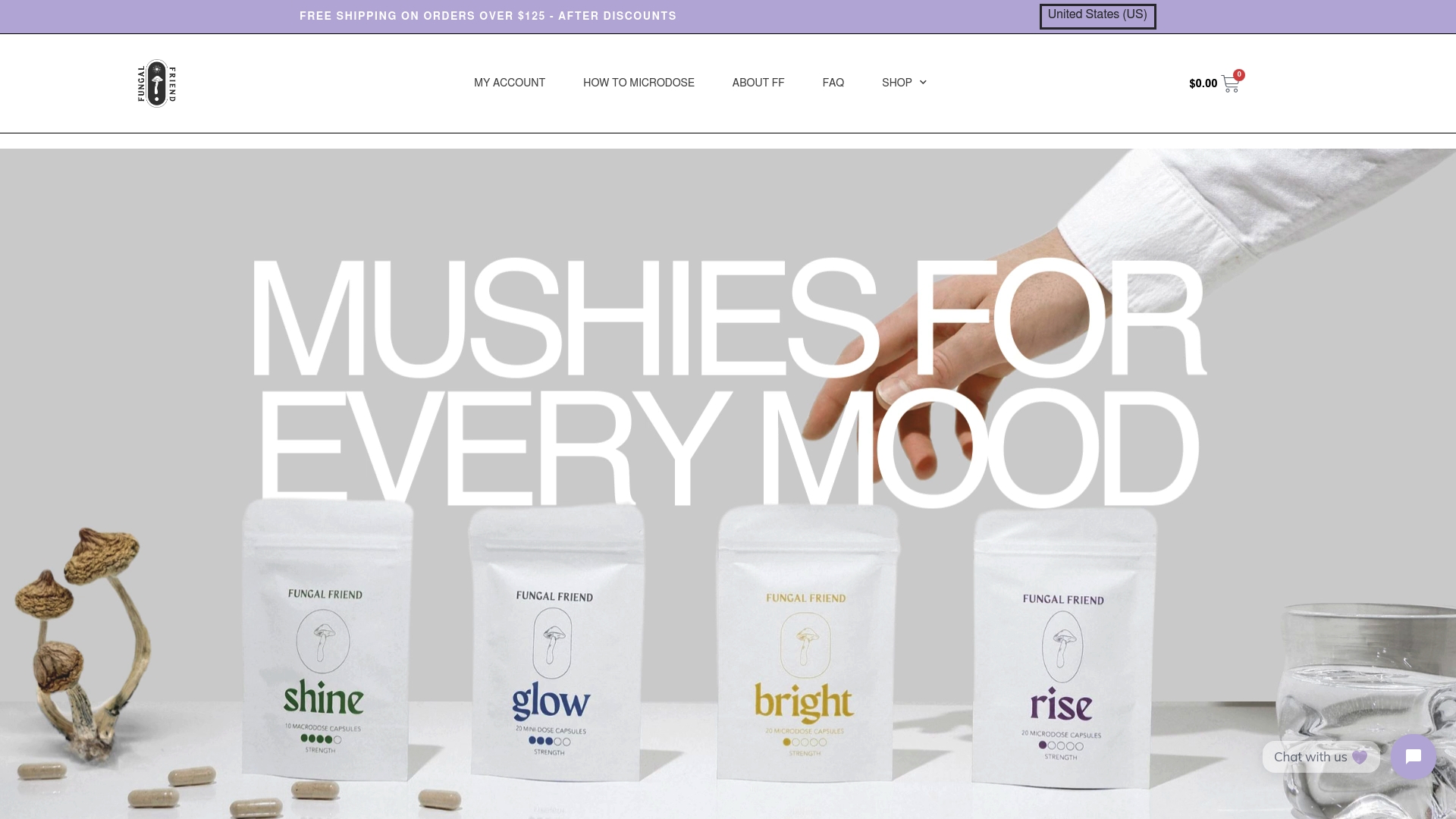
Explore our Uncategorized Archives – Fungal Friend for insights on dosage and strain effects. Begin your journey today with confidence by visiting Fungal Friend and discover natural, safe, and legal microdosing solutions crafted to help you achieve the sustained mental clarity described in this microdosing workflow. Take control of your focus now and experience the benefits of a well-supported practice.
Frequently Asked Questions
What are the steps to assess my readiness for microdosing?
To assess your readiness for microdosing, conduct a self-evaluation of your current mental state, stress levels, and professional goals. Consider documenting your findings and set specific, measurable goals to align with your focus enhancement objectives.
How do I select quality microdose products for mental clarity?
Begin by researching reputable sources that provide information on product purity, third-party lab testing, and the recommended strain characteristics. Prioritize products that align with your health profile and start with a low initial dose, adjusting as needed based on your body’s response.
What is an effective microdosing schedule to enhance focus?
An effective microdosing schedule typically follows the Fadiman Protocol, which involves dosing for one day followed by two rest days. Choose specific days of the week for dosing that minimize disruptions to your workflow, allowing for easier tracking of your cognitive response.
How can I track my focus levels while microdosing?
You can track your focus levels by creating a structured framework that includes daily focus intensity, productivity metrics, and emotional stability. Use a scoring system to rate these metrics on a scale of 1-10 to notice subtle changes in your cognitive landscape.
How do I evaluate my microdosing workflow’s success?
To evaluate your microdosing workflow’s success, conduct periodic reviews that assess cognitive performance, emotional shifts, and professional productivity changes. Compare these findings with your initial goals and be open to adjusting your dosage or schedule based on your reflections and data.