
Microdosing psilocybin for productivity: what 1,435 users show
TL;DR:
- Microdosing involves taking tiny psilocybin doses for mood, focus, and creativity without hallucinations.
- Scientific studies show temporary benefits on dosing days, but placebo effects largely explain these improvements.
- Safety tips include starting low, following structured protocols, and acknowledging legal and individual response considerations.
Thousands of Canadians are quietly swapping their morning coffee ritual for something far more unconventional: a sub-perceptual dose of psilocybin mushrooms. Self-reported gains from large user surveys point to real improvements in productivity and focus on dosing days, yet controlled trials tell a more complicated story. So what’s actually happening when you microdose? This guide breaks down the science, the mechanisms, the honest risks, and the practical steps that matter most for Canadians who want to use psilocybin thoughtfully rather than blindly chase a productivity trend.
Table of Contents
- What is microdosing and why is it popular for productivity?
- How does microdosing psilocybin affect brain and behavior?
- Evidence: productivity, focus, and creativity gains
- Risks, limitations, and guidance for Canadians
- A fresh perspective: separating hype from evidence
- Discover safe microdosing solutions and expert guidance
- Frequently asked questions
Key Takeaways
| Point | Details |
|---|---|
| Mixed evidence for benefits | Microdosing shows short-term productivity gains in self-reports, but scientific studies find little cognitive improvement beyond placebo. |
| Effects are acute | Improvements in mood, focus, and creativity occur mainly on dosing days and do not persist off-days. |
| Risks are mild | Microdosing is generally safe with mild risks such as anxiety and bodily discomfort, but should be used with caution. |
| Guidance for Canadians | Health Canada-approved guidance emphasizes responsible use, low doses, and observing off-days to minimize tolerance. |
What is microdosing and why is it popular for productivity?
Microdosing means taking a dose of psilocybin so small it produces no hallucinations, no altered perception, and no impairment. We’re talking roughly 0.05 to 0.3 grams of dried mushrooms, taken on a structured schedule like the popular Fadiman protocol: one day on, two days off. The goal is to stay fully functional while nudging your brain toward better mood, sharper focus, and more creative thinking.
For Canadians, the appeal is easy to understand. Many people are exhausted by the side effects of pharmaceutical stimulants or simply want a more natural path to mental performance. Psilocybin fits neatly into a broader wellness movement that prioritizes plant-based, holistic approaches over synthetic quick fixes. If you want a clear starting point, the what is microdosing psilocybin page at Fungal Friend covers the basics in plain language.
Here’s what draws most people to microdosing for productivity specifically:
- Mood lift without sedation. Unlike some anxiety medications, psilocybin at micro-doses tends to sharpen rather than dull mental clarity.
- Creativity on demand. Many users report that ideas flow more easily on dosing days, making it appealing for writers, designers, and problem-solvers.
- No crash. There’s no caffeine-style energy spike followed by a slump.
- Natural origin. Psilocybin mushrooms have been used by humans for thousands of years, which matters to people skeptical of synthetic compounds.
“Microdosing appeals for subtle neuroplasticity effects without the full psychedelic experience, offering potential anti-inflammatory and mood-regulating benefits that interest both researchers and everyday users.”
The mindful microdosing guide at Fungal Friend is worth reading before you start, because protocol and intention matter more than most people realize.
How does microdosing psilocybin affect brain and behavior?
Psilocybin converts to psilocin in the body, which then acts as an agonist at serotonin 5-HT2A receptors in the brain. This interaction is what drives most of microdosing’s reported effects. At full doses, this produces vivid hallucinations. At micro-doses, the effect is far subtler but still measurable at the neurological level.
One of the most interesting outcomes is an increase in brain-derived neurotrophic factor, or BDNF. Think of BDNF as fertilizer for your neurons. It supports the growth of new neural connections, which is the foundation of learning, adaptability, and what researchers call neuroplasticity. Mechanisms behind neuroplasticity from psilocybin are actively studied, and early findings are genuinely promising.
Microdosing also appears to quiet the default mode network, or DMN. The DMN is the part of your brain that runs when you’re daydreaming, ruminating, or stuck in repetitive thought loops. Reducing DMN activity is associated with better focus and less mental chatter, which is exactly what productivity-focused users are after. Research on psilocybin mood science continues to expand as more institutions take interest.
| Effect | Mechanism | Timing |
|---|---|---|
| Improved mood | 5-HT2A receptor activation | Acute (dosing day) |
| Sharper focus | Reduced DMN activity | Acute (dosing day) |
| Creative thinking | Increased neural connectivity | Acute (dosing day) |
| Neuroplasticity support | BDNF increase | Cumulative, ongoing |
A landmark Canadian research study at UBCO confirmed that microdosers experience acute gains in mood, creativity, and productivity specifically on the days they dose. Crucially, these benefits did not persist on off-days, which is an important nuance we’ll return to. If you’re curious about real-world outcomes, psilocybin tea results from Canadian users offer an interesting window into how different formats affect experience.

Pro Tip: Tolerance to psilocybin builds quickly. Sticking to a structured protocol with regular off-days is not optional. It’s the difference between sustained benefit and diminishing returns.
Evidence: productivity, focus, and creativity gains
With the mechanisms in mind, let’s review the scientific evidence for productivity and creativity gains from microdosing.
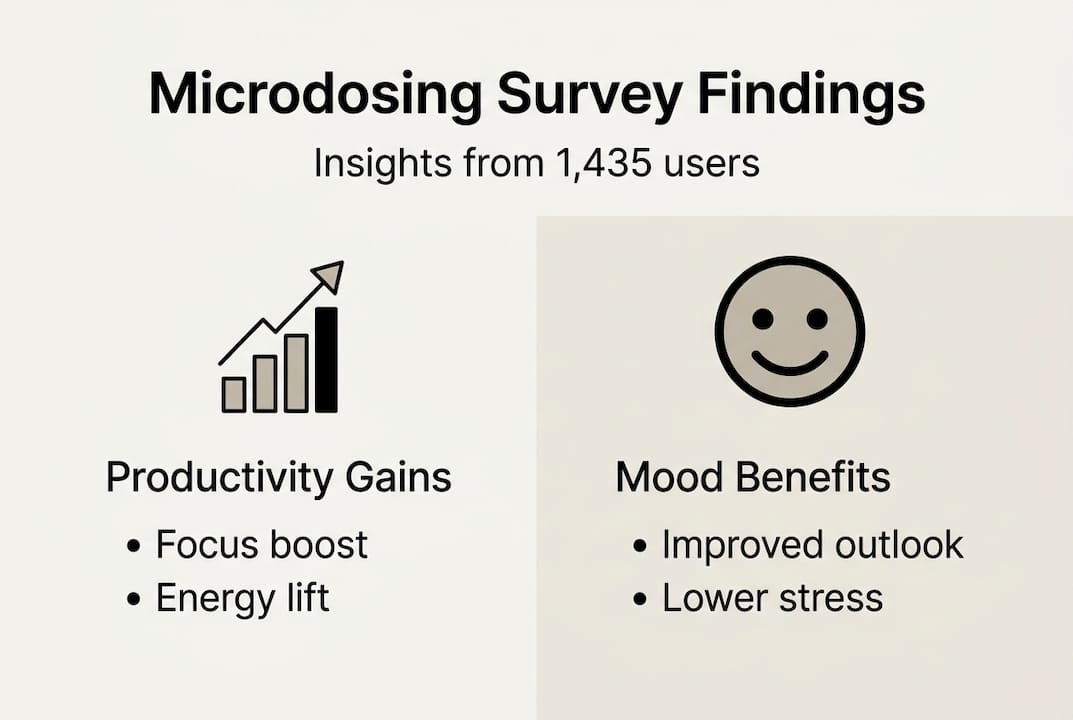
The most encouraging data comes from large self-report surveys. One study involving 1,435 participants showed acute productivity and focus improvements on dosing days, with users reporting higher energy, better concentration, and more creative output. People with prior experience at full psychedelic doses showed even greater creativity gains compared to first-time microdosers.
Here’s how self-reported findings compare to controlled research:
| Study type | Sample size | Productivity finding |
|---|---|---|
| Self-report surveys | 1,435 users | Acute gains in focus, creativity, mood |
| Placebo-controlled trials | 14 studies (meta-analysis) | No reliable cognitive benefit (d = -0.06) |
| Observational (UBCO) | Canadian cohort | Temporary mood and productivity boost |
That effect size of d = -0.06 from the placebo-controlled meta-analysis is essentially zero. When researchers control for expectation and belief, the cognitive improvements largely disappear. This is a significant finding that the microdosing community often glosses over.
So what explains the gap? A few factors are likely at play:
- Expectancy effect. If you believe a substance will improve your focus, your brain often cooperates. This is the placebo effect in action, and it’s powerful.
- Mood as a proxy. Feeling better emotionally translates into working better. The productivity gain may be a downstream effect of mood improvement, not direct cognitive enhancement.
- Selection bias. People who choose to microdose and then report on it tend to be motivated, health-conscious, and already optimizing their routines. Their results may not reflect the average person.
For those interested in creativity and focus gains, the evidence is more nuanced than most blog posts admit. And the safe microdosing guide at Fungal Friend helps you approach this with realistic expectations rather than hype.
Risks, limitations, and guidance for Canadians
Despite promising findings, microdosing’s risks, limitations, and best practices deserve careful attention, especially for Canadians navigating a still-evolving legal landscape.
The good news is that the risk profile for microdosing is generally mild. Reported risks include anxiety and bodily discomfort, but no serious adverse events have been documented in clinical trials. That said, individual responses vary significantly. Some people feel overstimulated or anxious at doses that others find perfectly comfortable.
Here are the key risks and limitations to keep in mind:
- Anxiety and overstimulation. Even sub-perceptual doses can amplify existing anxiety in sensitive individuals.
- Tolerance buildup. Psilocybin tolerance develops fast. Without proper off-days, effects diminish quickly.
- Acute-only benefits. Gains in mood and focus appear only on dosing days. There is no evidence of lasting cognitive enhancement.
- Interaction risks. If you take SSRIs or other serotonergic medications, combining them with psilocybin can reduce effects or, in rare cases, cause complications.
- Legal nuance. Psilocybin remains a controlled substance in Canada, though the landscape is shifting. A Health Canada-approved trial at Queen’s University signals growing institutional acceptance of research in this area.
For Canadians specifically, the Canadian safe microdosing guide outlines what you need to know about sourcing, dosing, and staying informed. The safe microdosing method page goes deeper on protocol specifics.
Pro Tip: Start at the lowest possible dose, around 0.05 to 0.1 grams, and stay there for at least two weeks before adjusting. Rushing to increase your dose is the most common mistake new microdosers make.
A fresh perspective: separating hype from evidence
Here’s the honest take: microdosing psilocybin is not a productivity hack. Not in the way that term usually gets used. The productivity community loves a clean, repeatable system, and microdosing doesn’t quite fit that mold.
The self-reported improvements are real to the people experiencing them. We don’t dismiss that. But controlled trials show no reliable cognitive gains beyond what placebo produces, and that matters. It means the mechanism of benefit is likely more emotional than neurological, at least at the cognitive performance level.
What microdosing may actually be doing is lowering the friction between you and your work. When your mood is better, your anxiety is quieter, and your mental chatter is reduced, you naturally focus better. That’s not nothing. That’s actually significant. But it’s not the same as a direct cognitive enhancer.
The users who get the most from microdosing tend to pair it with strong fundamentals: good sleep, regular movement, clear daily priorities, and intentional rest. They use it as a complement to a healthy routine, not a replacement for one. The psilocybin microdosing guide reflects this integrated approach, and it’s the framing we think serves Canadians best.
Discover safe microdosing solutions and expert guidance
If this article has clarified your thinking and you’re ready to explore microdosing with a grounded, evidence-aware approach, Fungal Friend has the resources to support you.
Start with the microdosing safety and wellness guide for a clear overview of dosing, scheduling, and what to realistically expect. If you’re brand new to this, the beginner microdosing guide walks you through every step without overwhelming you. When you’re ready to shop, browse the full selection of microdose mushroom capsules for convenient, precisely measured options crafted for daily use. Every product comes with discreet delivery across Canada.
Frequently asked questions
Does microdosing psilocybin reliably boost productivity?
While self-reports show acute productivity gains on dosing days, placebo-controlled trials reveal no consistent cognitive improvement beyond expectancy effects. The benefit is real for many users but may be driven more by mood than direct brain enhancement.
Is microdosing psilocybin legal in Canada?
Psilocybin remains a controlled substance in Canada, though the regulatory environment is evolving. A Health Canada-approved trial at Queen’s University reflects growing institutional support for clinical research into microdosing.
Are the effects of microdosing persistent or only temporary?
Productivity and focus gains are acute and dosing-day specific, meaning they appear only when you dose and do not carry over to off-days. No evidence currently supports lasting cognitive enhancement from microdosing alone.
What are the main risks of microdosing psilocybin?
Risks are generally mild, including occasional anxiety and bodily discomfort, with no serious adverse events reported in clinical settings. Individual sensitivity varies, and tolerance can develop without proper off-day protocols.
How can Canadians start microdosing psilocybin safely?
Begin with the lowest effective dose, follow a structured protocol with regular off-days, and use Health Canada-approved research as your benchmark for safety. Monitoring your response over several weeks before adjusting is the most reliable approach.