
Why choose blended psilocybin products for wellness
TL;DR:
- Blended psilocybin products combine mushrooms with herbs to modify effects and target specific outcomes.
- These products are unregulated, with risks of inconsistent dosing and unknown ingredient interactions.
- Consumers should prioritize transparency, lab testing, and legal understanding before purchase and use.
Thousands of Canadians are quietly reaching for blended psilocybin products, even though these items exist in a legal gray area with zero quality oversight. The market is growing fast, and so is the confusion around it. Are blends actually safer? Do the added ingredients do anything meaningful? Or is blending just clever marketing layered on top of an unregulated substance? Whether you are brand new to microdosing or you have been at it for a while, understanding what goes into a blended product and why it matters could be the difference between a helpful experience and a frustrating one. This guide breaks it all down clearly.
Table of Contents
- What are blended psilocybin products?
- Why people choose blends over pure psilocybin
- Safety, legality, and quality concerns in Canada
- Making an informed choice: Questions to ask and practical steps
- Our perspective: What most guides miss about blends
- Ready to explore safe psilocybin blends?
- Frequently asked questions
Key Takeaways
| Point | Details |
|---|---|
| Blended product basics | Blended psilocybin mixes psilocybin with other functional ingredients for a tailored experience. |
| Potential benefits | Blends are chosen for milder onset or additional support but lack formal research validation. |
| Safety first | Unregulated blends pose risks, especially for those with mental health concerns or medication use. |
| Informed decision | Ask about ingredients, testing, and source before trying any product. |
What are blended psilocybin products?
Blended psilocybin products are exactly what they sound like: formulations that combine psilocybin-containing mushrooms with other functional ingredients. Those added ingredients might include adaptogenic mushrooms like lion’s mane or reishi, herbs like ashwagandha or passionflower, or other compounds aimed at shaping the overall experience. The goal is usually to broaden the product’s effects, smooth out the intensity of psilocybin, or target a specific outcome like focus, sleep, or stress relief.
This is a meaningful departure from pure psilocybin preparations, which contain only the mushroom or its isolated compound. Pure products give you a more direct, predictable interaction with psilocybin itself. Blended products introduce variables. Some of those variables may work in your favor. Others may complicate things.
You will find blended psilocybin products in several formats:
- Capsules: Often the most precise format, listing milligrams per ingredient
- Teas: Infused with herbs and functional mushrooms for a gentler ritual
- Chocolates: Blended into a carrier that also masks the earthy taste of mushrooms
- Tinctures: Less common but growing in popularity for faster absorption
It is worth knowing that blended products are unregulated and not approved by Health Canada. They sit firmly in the gray market, meaning no government body is checking the label claims, the actual psilocybin content, or the purity of the added ingredients.
There is also a separate category worth mentioning: non-psilocybin adaptogen blends. These products contain zero psilocybin and are made entirely from functional mushrooms and herbs. They are legal and widely available. Knowing the difference matters, especially if you are new to this space. Understanding mushroom capsule ingredients is a smart first step before you buy anything.
Why people choose blends over pure psilocybin
With the definitions clear, let’s understand why many Canadians, especially first-timers, lean toward blends.
The most common reason is intensity. Pure psilocybin, even at microdose levels, can feel sharper or more unpredictable for someone who has never used it. Blends that include calming herbs or adaptogenic mushrooms are perceived as offering a softer entry point. Users often report that the onset feels more gradual and the overall experience feels more balanced.
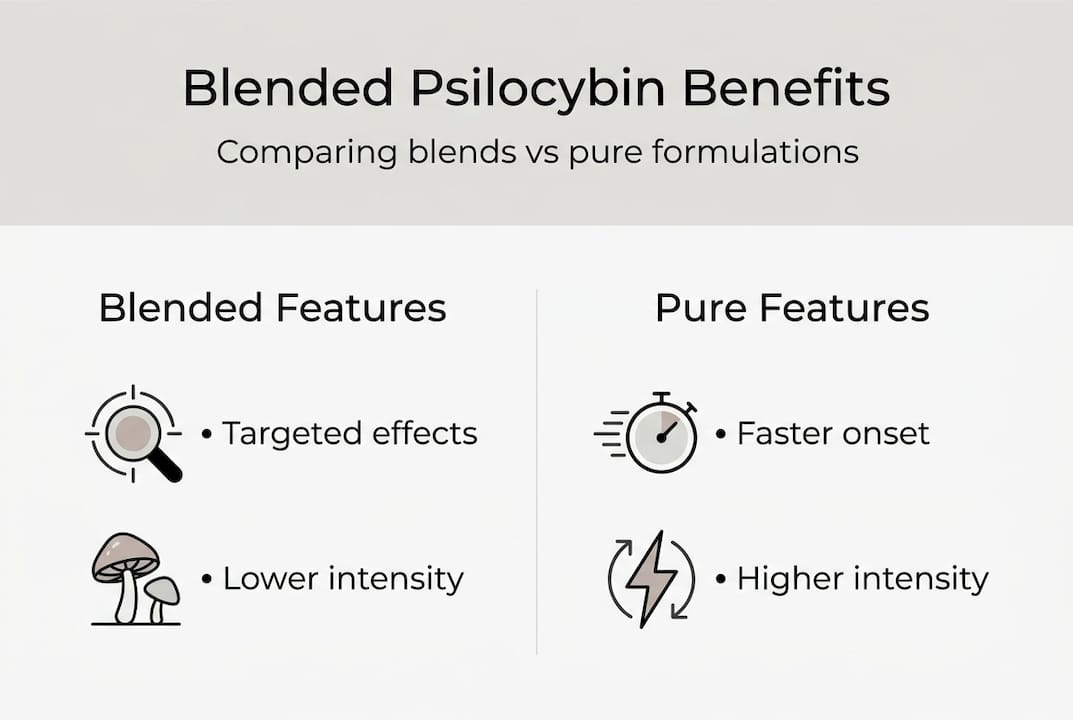
Here is a quick comparison of what users typically report between pure and blended products:
| Feature | Pure psilocybin | Blended psilocybin |
|---|---|---|
| Onset speed | Faster | Often slower |
| Intensity | More direct | Perceived as milder |
| Targeted effects | Limited | Broader (focus, calm, etc.) |
| Dosing clarity | More predictable | Variable by formula |
| Beginner friendliness | Moderate | Often preferred |
The appeal of targeting specific outcomes is real. Someone dealing with anxiety might choose a blend that pairs psilocybin with reishi or ashwagandha. Someone seeking focus might look for lion’s mane combined with a low psilocybin dose. These combinations make intuitive sense, and many users swear by them.
However, anecdotal evidence suggests synergy in blended products, but randomized clinical trials are still needed to confirm these effects. That gap between user experience and clinical proof is important to hold onto.
The risks of choosing blends are real too:
- Inconsistent dosing across products and batches
- Unknown interactions between psilocybin and added herbs
- Misleading labels that overstate ingredient quantities
- Unpredictable effects for those with sensitivities
Pro Tip: If you are new to psilocybin, start with the lowest available dose in any blended product and wait at least 90 minutes before considering more. Blends can behave differently than you expect. Learning about microdose effects before your first session will help you set realistic expectations.
Safety, legality, and quality concerns in Canada
Now that you know the appeal, it is crucial to examine safety and legal status before making any decisions.
Let’s be direct: psilocybin sales remain illegal in Canada except through research programs or the Special Access Program. The gray market operates outside this framework entirely. That means no standardized testing, no mandatory labeling requirements, and no accountability if a product harms you.
Here is how authorized and gray-market products compare:
| Factor | Authorized (SAP/Research) | Gray market |
|---|---|---|
| Legal status | Permitted under specific conditions | Illegal for general sale |
| Quality testing | Required | Not required |
| Dosing accuracy | Verified | Unverified |
| Ingredient transparency | Mandatory | Optional |
| Consumer protection | Yes | No |
The risks in the gray market are not hypothetical. Contamination is a real concern, particularly with products that combine multiple ingredients. Inaccurate dosing is common. And for vulnerable populations, the consequences can be serious.
People who should avoid blended psilocybin products entirely:
- Anyone with a personal or family history of psychosis or schizophrenia
- People currently taking SSRIs, MAOIs, or other psychiatric medications
- Pregnant or breastfeeding individuals
- Anyone under 19 years of age
- Those in acute mental health crises
Red flags to watch for when evaluating a vendor include: no ingredient list, no third-party lab testing, no clear contact information, and pressure tactics that discourage questions. A trustworthy source will answer your questions openly.
For a deeper look at where Canadian law stands right now, safe access in 2026 is a useful resource. And if you want to understand the broader framework around harm reduction, reviewing psilocybin safety rules gives you the full picture.
Making an informed choice: Questions to ask and practical steps
Understanding the safety and legality concerns sets the stage for making a truly informed product choice.
Before you buy any blended psilocybin product, work through these questions:
- Does the vendor publish a full ingredient list? Every ingredient, including inactive ones, should be clearly listed with quantities.
- Is there third-party lab testing available? Look for a certificate of analysis (COA) from an independent lab, not just the manufacturer’s claims.
- What is the psilocybin content per dose? Vague descriptions like “a small amount” are red flags.
- What do verified user reviews say? Look beyond the vendor’s own site for honest feedback.
- Does the vendor answer questions directly? Responsive, knowledgeable customer support is a positive signal.
- Have you researched the added ingredients separately? Some herbs interact with medications or have their own contraindications.
For practical use, follow these steps:
- Store products in a cool, dark, dry place away from children
- Start with the lowest suggested dose and track your response in a journal
- Never combine with alcohol or other substances on your first use
- Give yourself a full day with no obligations for your first experience
“The most important thing you can do before trying any psilocybin product is research. Not just the product, but yourself. Your mental health history, your current medications, and your intentions all matter.”
As gray-market blends spread, users who stay informed and ask the right questions are far better protected than those who rely on packaging alone. For a step-by-step framework on responsible use, the psilocybin consumption workflow is worth bookmarking.
First-timers should prioritize simplicity: fewer ingredients, lower doses, and a trusted source. Experienced microdosers can experiment more, but even they benefit from revisiting the basics when switching products.
Our perspective: What most guides miss about blends
Here is something most articles will not tell you: blended psilocybin products are not automatically safer just because they contain more ingredients. That assumption is one of the most common and potentially costly mistakes we see.
The real variable is not whether a product is blended. It is whether the vendor behind it operates with transparency and genuine care for the user. A pure psilocybin product from a rigorous, honest source will almost always be a better choice than a heavily blended product from a vendor who cannot tell you what is actually in it.
We have seen users chase complexity, stacking blends with adaptogens and nootropics, when what they actually needed was a simple, well-sourced low dose and patience. Personalization matters enormously in this space. What works for one person may do nothing for another, or worse, cause discomfort.
The uncomfortable truth is that the blend itself is secondary. Sourcing, transparency, and self-knowledge are primary. Understanding why legality matters is not just a legal exercise. It is a proxy for product quality and vendor accountability. When a vendor operates with integrity within a complex legal landscape, that tells you something real about how seriously they take your safety.
Ready to explore safe psilocybin blends?
If this article has given you a clearer picture of blended psilocybin products, the next step is putting that knowledge to work. At Fungal Friend, we believe education comes before every purchase.
Start with our microdosing guide for a full breakdown of safe doses and what to expect. If you are just getting started, the beginner microdosing guide walks you through everything from your first dose to building a sustainable practice. When you are ready to browse products, our mushroom capsules section offers clearly labeled options with ingredient transparency. We are here to help you make informed, safe choices every step of the way.
Frequently asked questions
Are blended psilocybin products legal in Canada?
Psilocybin is illegal for general sale or possession in Canada. Blended psilocybin products are only permitted through clinical trials or the Special Access Program, which requires a formal application and medical oversight.
Are blended psilocybin products safer than pure psilocybin?
Some users find blends feel less intense, but quality is unregulated in the gray market, meaning both pure and blended products carry similar safety risks. The added ingredients in a blend introduce their own unknowns.
What should I look for when choosing a blended psilocybin product?
Prioritize vendors who publish full ingredient lists, provide third-party lab results, and have verifiable positive reviews from real users. Avoid any product that cannot clearly state its psilocybin content per dose.
Who should avoid blended psilocybin products?
Anyone with a personal or family history of psychiatric conditions, or those currently taking psychiatric medications, should avoid blends entirely. Psilocybin poses additional risks for these groups, and the added ingredients in blends may compound those risks further.