
How to track microdose effects for mental health 2026
Microdosing psilocybin is gaining traction across Canada as adults seek natural support for anxiety, focus, and mood balance. Yet tracking these subtle mental health shifts poses a real challenge: effects are often barely perceptible, and separating genuine improvements from placebo or daily mood swings requires disciplined observation. This guide walks you through safe, evidence-based methods to monitor your microdosing outcomes in 2026, helping you compare dosing and non-dosing days, interpret your data objectively, and make informed decisions about your wellness journey.
Table of Contents
- What You Need To Track Microdose Effects Safely And Effectively
- How To Track Microdose Effects Step-By-Step: Methods And Examples
- Troubleshooting Common Challenges And Interpreting Your Data
- Understanding Results: What To Expect And Next Steps
- Explore Safe Microdosing Resources And Products At Fungal Friend
- How To Track Microdose Effects: Frequently Asked Questions
Key takeaways
| Point | Details |
|---|---|
| Comparative tracking | Effective monitoring compares microdose days with non-dosing days using structured self-assessments to reveal patterns. |
| Digital tools | Apps like Dose and Microdose.me provide structured logging and visualization of mood, energy, and productivity metrics. |
| Standardized scales | Weekly use of PHQ-9 and GAD-7 scales helps track anxiety and depression reliably over time. |
| Placebo awareness | Naturalistic studies show strong self-reported benefits, but controlled trials highlight expectancy effects requiring blind tracking. |
| Professional guidance | Lab-tested products and healthcare consultation ensure safety and accurate interpretation for Canadian users. |
What you need to track microdose effects safely and effectively
Before you begin tracking, preparation is everything. You need the right materials, safety protocols, and legal awareness to monitor microdose effects responsibly in Canada.
Start by sourcing lab-tested psilocybin products. Dosage accuracy is critical for meaningful tracking, and unverified sources introduce variables that muddy your data. Prioritize lab-tested sources and consult health professionals for mental health conditions, as psilocybin is Schedule III with possible exemptions in Canada. If you have pre-existing mental health conditions or take medications, professional consultation is non-negotiable. Interactions and contraindications can skew results or pose risks.
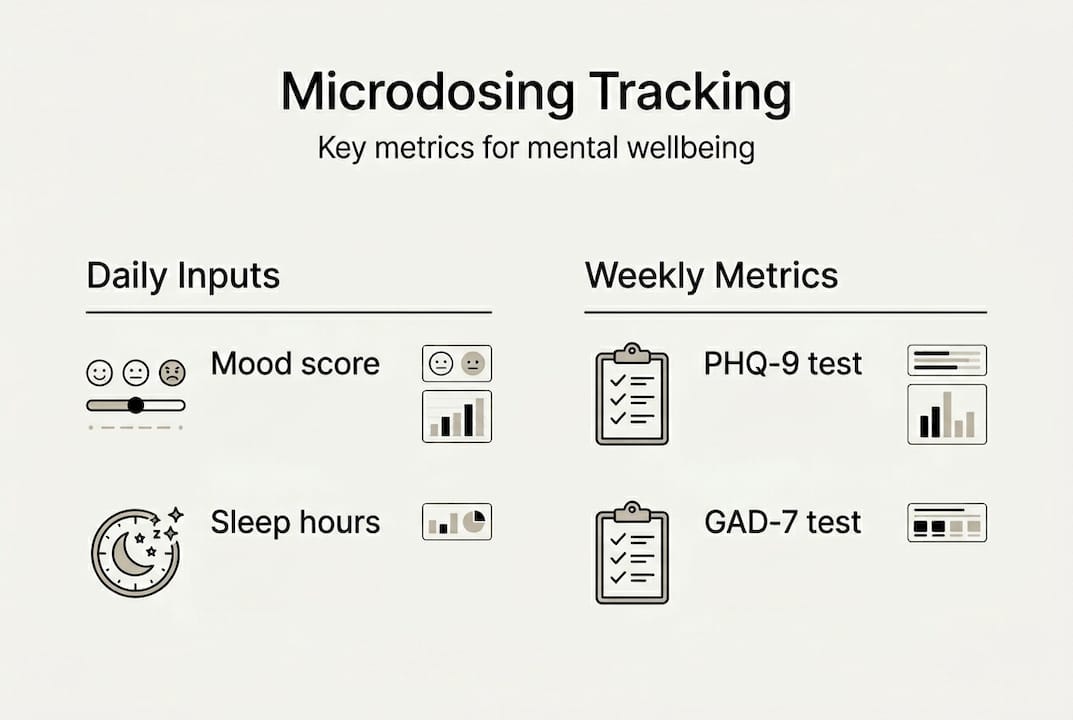
Next, gather your tracking tools. Digital apps like Dose or Microdose.me offer structured frameworks for logging doses, mood, energy, sleep quality, and productivity daily. These platforms often include data visualization features that help you spot trends over weeks or months. Supplement app tracking with standardized mental health scales such as the PHQ-9 for depression and GAD-7 for anxiety. Weekly assessments using these validated instruments provide objective benchmarks that counteract subjective bias.
A daily journal rounds out your toolkit. Record not just your microdose timing and amount, but also external factors like sleep quality, exercise, diet changes, stressful events, or social interactions. These contextual notes help you rule out confounders when analyzing patterns later.
Understand the legal landscape. Psilocybin remains a controlled substance in Canada, but exemptions exist for certain therapeutic and research contexts. Familiarize yourself with the legal considerations psilocybin canada 2026 to ensure your tracking practice stays compliant and informed.
Finally, choose a dosing protocol before you start. The Fadiman protocol (dose one day, off two to three days) and Stamets protocol (four days on, three off) are popular frameworks that build consistency into your routine. Consistency matters because it lets you compare equivalent periods and detect real shifts rather than random noise.
Pro Tip: Create a microdosing safety checklist canada before your first dose to ensure you have all materials, understand contraindications, and set clear tracking goals.
| Essential Item | Purpose |
|---|---|
| Lab-tested psilocybin | Ensures accurate dosing and safety |
| Digital tracking app | Logs daily metrics and visualizes trends |
| PHQ-9 and GAD-7 scales | Provides objective mental health benchmarks |
| Daily journal | Records external factors and subjective notes |
| Dosing protocol | Maintains consistency for comparative analysis |
How to track microdose effects step-by-step: methods and examples
With preparation complete, you can begin systematic tracking. Follow these steps to capture meaningful data on mood and focus changes.
First, establish your baseline. Before taking your first microdose, complete a week of daily tracking without any psilocybin. Log your mood, energy, focus, sleep, and productivity using your chosen app and standardized scales. This baseline week gives you a reference point for later comparisons.
Next, begin microdosing according to your selected protocol. On dosing days, log the exact time and amount you consume. Throughout the day, record your mood and focus at consistent intervals, such as morning, midday, and evening. Note any shifts in energy, creativity, emotional tone, or cognitive clarity. On non-dosing days, maintain the same tracking routine without taking psilocybin.

Use your digital app to track on microdosing vs non-microdosing days using self-assessments for wellbeing, productivity, creativity, and focus, which show significant improvements on dosing days in naturalistic studies. Apps like Microdose.me allow you to tag entries as dosing or non-dosing days, making it easy to filter and compare later.
Weekly, complete your PHQ-9 and GAD-7 assessments. These standardized scales take only a few minutes but provide objective scores that track anxiety and depression trends over time. Record these scores in your app or journal for longitudinal analysis.
Incorporate external factor notes daily. Did you sleep poorly? Experience a stressful work deadline? Have an unusually social weekend? These variables influence mood and focus independently of microdosing. Logging them helps you identify when a mood shift is likely due to psilocybin versus life circumstances.
After four to six weeks, review your data. Look for patterns: Do you consistently report higher focus or lower anxiety on dosing days compared to non-dosing days? Are improvements sustained across multiple cycles, or do they fade? Use your app’s visualization tools to graph mood and productivity scores over time, comparing dosing and non-dosing periods side by side.
Pro Tip: For deeper insights, explore psilocybin dosage guidelines 2026 safe microdosing to fine-tune your dose based on tracked outcomes and personal response.
- Establish a one-week baseline by tracking mood, energy, focus, and sleep without microdosing.
- Begin your chosen protocol and log exact dose timing and amount on dosing days.
- Record mood and focus metrics at consistent daily intervals on both dosing and non-dosing days.
- Complete weekly PHQ-9 and GAD-7 assessments to track anxiety and depression objectively.
- Note external factors like sleep quality, stress, and social events to identify confounders.
- After four to six weeks, analyze patterns by comparing dosing and non-dosing day data using app visualizations.
| Metric | Dosing Day Example | Non-Dosing Day Example |
|---|---|---|
| Morning mood (1-10) | 7 | 5 |
| Focus during work (1-10) | 8 | 6 |
| Energy level (1-10) | 7 | 6 |
| Sleep quality (1-10) | 8 | 7 |
| Productivity tasks completed | 6 | 4 |
For additional context on microdosing frameworks and benefits, see microdosing protocols and benefits. Understanding these protocols helps you interpret your tracked data within established best practices.
Troubleshooting common challenges and interpreting your data
Even with careful tracking, you may encounter pitfalls that skew your observations or lead to misinterpretation. Recognizing these challenges helps you adjust your approach and draw accurate conclusions.
Expect subtle improvements, not dramatic shifts. Microdosing effects are often barely perceptible on any single day. Large individual variability is common, so what works for one person may differ significantly for another. Avoid the trap of expecting immediate, obvious changes. Real benefits emerge over weeks, not days.
Bias is a major obstacle. If you know you took a microdose, you may unconsciously attribute any positive mood or focus shift to the psilocybin, even if it stems from other factors. Self-reported benefits strong in naturalistic studies but contradicted by double-blind trials suggest placebo or expectancy effects, making blind tracking recommended. Consider having a trusted friend prepare your doses in identical capsules, some with psilocybin and some without, so you track without knowing which days you actually microdosed. This blind approach reduces expectancy bias.
Common mistakes undermine data quality. Inconsistent tracking, such as logging mood on some days but not others, creates gaps that prevent meaningful pattern detection. Ignoring external influences like poor sleep, illness, or major life events leads to false attribution of mood changes to microdosing. Neglecting non-dosing day data is another error: without a control comparison, you cannot distinguish microdose effects from natural fluctuations.
Use data visualization tools in your app to detect real trends. Graphs that overlay dosing days with mood or focus scores help you see whether improvements cluster around microdose days or appear randomly. If you notice no consistent pattern after six weeks, the effects may be negligible for you, or placebo effects may be at play.
Consult professionals for proper interpretation and safety guidance. A therapist or physician familiar with psychedelic research can help you assess whether tracked improvements justify continuing microdosing or suggest alternative approaches. They can also identify warning signs, such as increased anxiety or mood instability, that warrant stopping.
Pro Tip: Review risks of microdosing psilocybin to understand potential adverse effects and recognize when your tracked data signals a need to pause or adjust your protocol.
- Expect subtle, gradual improvements rather than dramatic immediate changes.
- Use blind tracking when possible to reduce expectancy and placebo bias.
- Avoid inconsistent logging, ignoring external factors, or neglecting non-dosing day comparisons.
- Leverage app visualization tools to identify genuine trends versus random noise.
- Consult healthcare professionals to interpret data safely and adjust your approach as needed.
“The most reliable microdosing insights come from comparing your own dosing and non-dosing days over extended periods, not from anecdotal reports or short-term observations.”
For harm reduction strategies and safe practices, explore psychedelic harm reduction safe microdosing canada 2026 to ensure your tracking journey prioritizes safety and informed decision-making.
Understanding results: what to expect and next steps
After weeks of diligent tracking, you face the critical task of interpreting your data and deciding your next steps. Realistic expectations and objective analysis are key.
Set realistic expectations from the start. Benchmarks show subtle mood and focus improvements; significant changes may reflect placebo or individual variability, and data comparison of dosing versus off-days is vital. Microdosing is not a cure-all. It may support your mental health as one component of a broader wellness approach that includes therapy, exercise, nutrition, and social connection.
Use your tracked data to benchmark your personal outcomes against typical ranges. If your mood scores on dosing days average one to two points higher on a ten-point scale compared to non-dosing days, and this pattern holds across multiple weeks, you have evidence of a modest but real effect. If improvements are inconsistent or indistinguishable from non-dosing days, the benefits may be minimal for you.
Decide whether to continue, adjust dosing, or consult professionals based on objective trends. If tracking reveals consistent benefits without adverse effects, you might continue your protocol and monitor long-term sustainability. If effects plateau or diminish over time, consider adjusting your dose or taking a break to reset tolerance. If you notice increased anxiety, mood swings, or other negative patterns, stop microdosing and seek professional guidance.
Understand that microdosing is one part of an overall wellness strategy. Even if your data shows positive trends, do not rely solely on psilocybin for mental health management. Integrate microdosing with evidence-based therapies, healthy lifestyle habits, and regular check-ins with healthcare providers.
Plan periodic reviews of your tracking for ongoing mental health monitoring and legal compliance. Every few months, reassess your data, update your goals, and ensure your practice aligns with current Canadian regulations. Staying informed about psilocybin microdosing canada 2026 safe wellness guide helps you adapt your approach as research and legal contexts evolve.
- Set realistic expectations: effects are often subtle and vary widely between individuals.
- Benchmark your tracked improvements against typical ranges to assess genuine impact.
- Decide whether to continue, adjust, or stop based on objective data trends and professional input.
- Recognize microdosing as one component of a holistic mental health strategy, not a standalone solution.
- Schedule periodic data reviews to monitor long-term patterns and ensure legal and safety compliance.
| Outcome Scenario | Recommended Next Step |
|---|---|
| Consistent improvements on dosing days | Continue protocol and monitor long-term sustainability |
| Minimal or inconsistent effects | Adjust dose, try different protocol, or take a break |
| Increased anxiety or negative patterns | Stop microdosing and consult a healthcare professional |
| Plateau after initial benefits | Reset tolerance with a break or explore complementary therapies |
For insights into evolving practices and trends, check out microdosing trends 2025 canada to see how Canadian users are integrating microdosing into their wellness routines and what emerging research suggests for the future.
Explore safe microdosing resources and products at Fungal Friend
Now that you understand how to track microdose effects for mental health, take the next step with expert guidance and trusted products tailored for Canadian users.
Fungal Friend offers a comprehensive beginner microdosing guide safe psilocybin use that walks you through every stage of starting your microdosing journey safely and effectively.
Access up-to-date psilocybin dosage guidelines 2026 safe microdosing to fine-tune your protocol based on the latest research and Canadian best practices. Explore detailed resources on safe microdosing method psilocybin to ensure your tracking efforts are supported by evidence-based protocols and harm reduction strategies. Whether you are just beginning or refining your approach, Fungal Friend provides the education and products to support your mental health goals responsibly.
How to track microdose effects: frequently asked questions
What are the best apps for tracking microdosing effects?
Dose and Microdose.me are popular choices that offer structured logging for dose timing, mood, energy, sleep, and productivity. Both apps provide data visualization tools to help you compare dosing and non-dosing days and identify trends over weeks.
How often should I assess my mental health when microdosing?
Track daily metrics like mood and focus at consistent intervals, and complete standardized scales such as PHQ-9 and GAD-7 weekly. This combination provides both granular daily insights and objective longitudinal benchmarks for anxiety and depression.
Can placebo effects influence microdosing results?
Yes, naturalistic studies show strong self-reported benefits, but controlled trials reveal significant placebo and expectancy effects. Blind tracking, where you do not know which days you actually microdosed, helps reduce bias and improve data accuracy.
Is it safe to track microdosing effects without medical supervision?
If you have pre-existing mental health conditions or take medications, professional consultation is essential to avoid contraindications and ensure safety. Even without these factors, consulting a healthcare provider familiar with psychedelic research can help you interpret your data and adjust your protocol responsibly.
How do I differentiate between microdose effects and natural mood fluctuations?
Compare tracked metrics between dosing and non-dosing days over multiple weeks, and log external factors like sleep, stress, and social events. Consistent patterns that favor dosing days across several cycles suggest genuine microdose effects, while random or inconsistent shifts likely reflect natural variability or external influences.