
Microdosing for anxiety: safe, evidence-based guide for Canadians
TL;DR:
- Microdosing involves small psilocybin doses aimed at mood and anxiety modulation without hallucinations.
- Evidence for microdosing’s effectiveness is mixed; placebo effects play a significant role in perceived benefits.
- Legal access in Canada is restricted; participation in approved trials or exemptions is necessary for safe use.
Microdosing psilocybin has exploded in popularity across Canada, with wellness communities, Reddit threads, and even mainstream news outlets buzzing about its potential to ease anxiety naturally. Yet most people exploring this path run into the same wall: confusing dosing advice, murky legal information, and clinical research that seems to contradict itself. Is microdosing genuinely effective, or is it mostly hype? The honest answer sits somewhere in the middle, and that nuance is exactly what most guides skip. This article cuts through the noise to give you a clear, evidence-based picture of what microdosing can and cannot do for anxiety, what the science actually says, and how Canadians can approach it responsibly in 2026.
Table of Contents
- What is microdosing and how does it work for anxiety?
- The evidence: Does microdosing really help with anxiety?
- Choosing safe strains and doses for anxiety relief
- Safety, risks, and legal access to microdosing in Canada
- A fresh perspective: Rethinking microdosing for anxiety in 2026
- Learn, compare, and explore safe microdosing options
- Frequently asked questions
Key Takeaways
| Point | Details |
|---|---|
| Microdosing defined | Microdosing means taking very small, sub-perceptual doses of psilocybin, usually 0.1-0.3g dried mushrooms. |
| Legal status in 2026 | Psilocybin remains illegal in Canada except in clinical trials or with special exemptions in 2026. |
| Mixed scientific evidence | User reports are positive but clinical trials show mixed results, with placebo effects being significant. |
| Strain and dose matter | Choosing gentle strains and starting with low doses is important for safety and effectiveness. |
| Safety first | Anyone with major mental or heart health issues should avoid microdosing and always consider legal and health risks first. |
What is microdosing and how does it work for anxiety?
Microdosing means taking a dose small enough that you don’t feel high. You’re not trying to trip. You’re aiming for a subtle shift in mood, focus, or emotional tone that stays below the threshold of obvious psychedelic effects. For psilocybin mushrooms, sub-perceptual doses of 0.1-0.3g dried Psilocybe cubensis (roughly 1-5mg of active psilocybin) are the standard range, taken on structured schedules like the Fadiman protocol (one day on, two days off) or the Stamets Stack (four days on, three days off, often combined with Lion’s Mane mushroom and niacin).
These schedules matter because psilocybin builds tolerance quickly. Taking it every day would blunt its effects within a week. The spacing is intentional, not arbitrary.
So how might this help with anxiety? The leading theory involves psilocin acting as a serotonin 5-HT2A agonist, which promotes neuroplasticity (your brain’s ability to form new connections), reduces overactivity in the default mode network (the brain region linked to rumination and self-criticism), and may lower neuroinflammation, a factor increasingly tied to anxiety disorders. Think of it as gently loosening rigid mental patterns rather than forcing a reset.
For a broader scientific overview of psilocybin’s mechanisms, the current research is promising but still developing. You can also explore Canada microdosing basics for a localized starting point.
Here’s a quick comparison of the two most common schedules:
| Schedule | Pattern | Common reported benefit |
|---|---|---|
| Fadiman protocol | 1 day on, 2 days off | Mood stability, reduced anxiety |
| Stamets Stack | 4 days on, 3 days off | Cognitive boost, neurogenesis support |
Common reasons Canadians explore microdosing for anxiety include:
- Persistent low-grade anxiety that doesn’t respond well to conventional treatments
- Desire to reduce reliance on SSRIs or benzodiazepines
- Interest in natural, plant-based mental health support
- Seeking improved emotional regulation and stress resilience
- Curiosity about neuroplasticity and long-term mood improvement
The evidence: Does microdosing really help with anxiety?
This is where things get genuinely interesting, and a little complicated. Observational studies (where researchers survey people who already microdose) consistently show that users report lower anxiety, better mood, and improved focus. That sounds encouraging. But observational data has a serious flaw: the people choosing to microdose are already motivated, hopeful, and self-selecting. Their positive results may say more about their mindset than the mushrooms.
When researchers run randomized controlled trials (RCTs), the picture shifts. Observational studies show reduced anxiety while RCTs often show benefits that don’t clearly exceed placebo. That’s a meaningful gap. It doesn’t mean microdosing does nothing, but it does mean we can’t yet say with confidence that the psilocybin itself is driving the improvement.
The placebo effect here is unusually powerful. Trial participation alone reduces symptoms, likely because participants feel seen, supported, and hopeful. That’s not a flaw in the research; it’s a clue about how anxiety works. Context, expectation, and community support are therapeutic in themselves.
Canadian clinical trials are actively working to untangle these variables, which is genuinely exciting for the field.
| Outcome type | Observational studies | RCTs |
|---|---|---|
| Anxiety reduction | Frequently reported | Modest, often near placebo |
| Mood improvement | Commonly noted | Inconsistent across trials |
| Cognitive clarity | Often reported | Limited controlled evidence |
| Side effects | Mild and infrequent | Similar to placebo groups |
“The most honest thing we can say right now is that microdosing shows real promise, but the evidence isn’t yet strong enough to make definitive clinical claims. That gap matters.”
Pro Tip: Think of microdosing as a potential tool in your anxiety toolkit, not a standalone cure. Pairing it with therapy, sleep hygiene, and exercise gives any intervention, including this one, a much better chance of working. Review the safety of microdosing and tolerance and dosing resources before starting.
Choosing safe strains and doses for anxiety relief
Not all psilocybin mushrooms are created equal. Potency varies significantly across strains, and choosing the wrong one as a beginner can turn a gentle mood lift into an overwhelming experience, even at supposedly “micro” doses.

For anxiety specifically, Psilocybe cubensis varieties like Golden Teacher, B+, and Mazatapec are widely recommended for first-timers. These strains are known for being gentler, more mood-balancing, and less likely to produce intense visual or emotional surges at low doses. They’re forgiving, which matters when you’re still calibrating your sensitivity.
Strains like Copelandia (also called Panaeolus cyanescens) are significantly more potent and require much lower doses to stay sub-perceptual. A “microdose” of Copelandia is not the same weight as a microdose of Golden Teacher. Mixing up strains without adjusting your dose is one of the most common beginner mistakes.
Here’s a practical three-step approach for selecting and adjusting your dose safely:
- Start at the floor. Begin with 0.05-0.1g of a mild strain like Golden Teacher. This is below the typical microdose range, but it lets you gauge your individual sensitivity before committing to a full protocol.
- Wait and observe. Give yourself at least two full dosing cycles (roughly two weeks on the Fadiman schedule) before adjusting. Anxiety, sleep quality, and mood shifts are the key signals to track.
- Adjust by 0.05g increments only. Small, deliberate changes prevent you from overshooting. The goal is sub-perceptual. If you notice the dose, it’s too high for a microdose.
For dosing guidelines that go deeper into potency differences, the external resources are worth reviewing before you start.
Pro Tip: Capsule products offer the most precision for microdosing. Pre-measured capsules remove the guesswork of weighing dried mushrooms, which can vary in moisture content and density. Also, read up on spacing doses to understand how tolerance accumulates and why rest days are non-negotiable.
Safety, risks, and legal access to microdosing in Canada
Let’s be direct about the legal reality first. In 2026, psilocybin is a Schedule III controlled substance in Canada. Possessing or selling it without a legal exemption is illegal, regardless of how many wellness blogs treat it as a gray area. There are three legitimate legal pathways: participation in a Health Canada-approved clinical trial, access through the Special Access Program (SAP) for serious medical cases, or a Section 56 exemption granted to specific individuals or organizations.
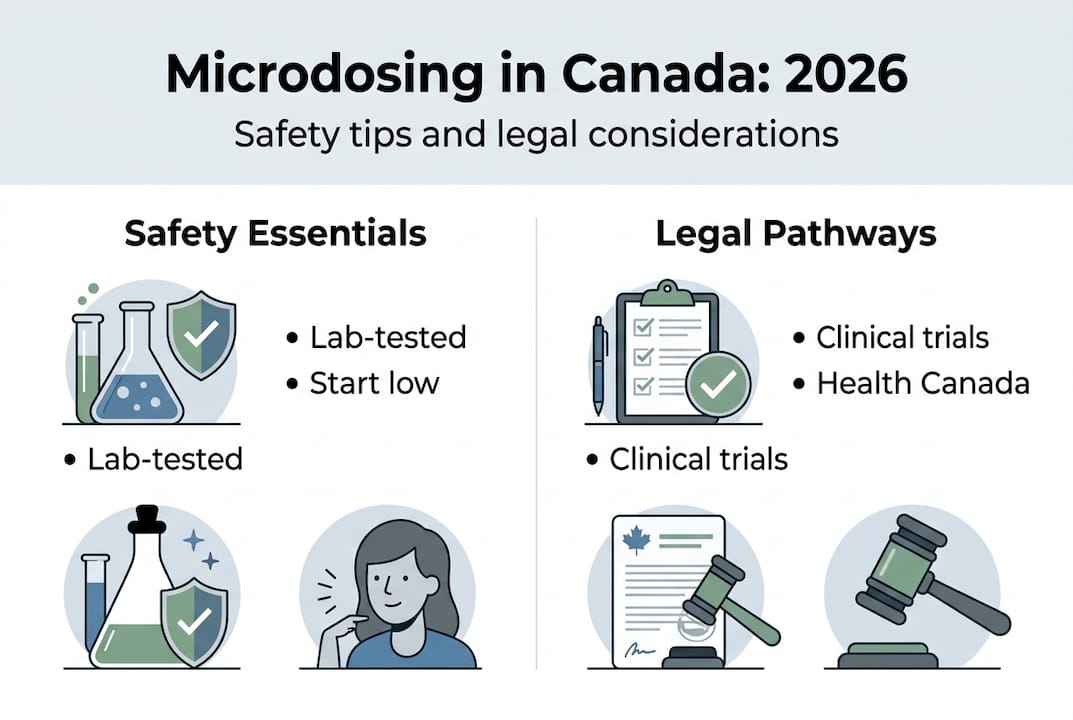
The KHSC Health Canada clinical trial is one example of a formal, legal pathway for Canadians to access microdosing under supervision. These programs are limited but growing.
Now, who should not microdose? This is critical. Avoid psilocybin entirely if you have:
- A personal or family history of schizophrenia, psychosis, or bipolar disorder
- Serious heart conditions (psilocybin affects serotonin receptors linked to cardiac function)
- A current pregnancy or breastfeeding situation
- Active use of lithium or MAOIs (dangerous interaction risk)
Approximately 20% of microdosers report mild side effects, including temporary anxiety spikes, nausea, headaches, or disrupted sleep. Serious risks are rare but the mild ones are real and worth planning for.
Safe practices to follow:
- Never microdose before driving or operating machinery
- Keep a simple journal to track mood, sleep, and any unusual reactions
- Start on a day off, not a workday, until you know how your body responds
- Have a trusted person aware of your protocol in case you need support
“Harm reduction isn’t just a buzzword. It’s the difference between a useful experience and a regrettable one.”
For a full breakdown, see psilocybin law in Canada and the 2026 dosing guide for current, Canada-specific guidance.
A fresh perspective: Rethinking microdosing for anxiety in 2026
Here’s something most microdosing content won’t tell you: the placebo effect isn’t a bug. It’s a feature worth understanding. If the act of intentionally caring for your mental health, tracking your mood, and engaging with a structured protocol produces real anxiety relief, that relief is still real. The mechanism just isn’t purely pharmacological.
We’ve seen recent trends push microdosing into mainstream wellness culture, and with that comes a lot of oversimplified messaging. The truth is that microdosing is not a one-size-fits-all remedy. Your anxiety has a history, a context, and specific triggers. A sub-perceptual mushroom dose doesn’t erase any of that.
What microdosing might do, for the right person with realistic expectations, is create a small window of neurological flexibility where therapy, reflection, or lifestyle changes land more effectively. That’s a meaningful but modest role. Canadians who approach it with legal awareness, honest expectations, and integration alongside other mental health strategies are the ones most likely to find genuine value in it.
Learn, compare, and explore safe microdosing options
If this guide has sparked genuine curiosity, the next step is building a solid knowledge base before you do anything else. Understanding the full picture, including legal realities, strain differences, and dosing precision, is what separates informed exploration from unnecessary risk.
At Fungal Friend, we’ve built resources specifically for Canadians navigating this space thoughtfully. Whether you’re just starting out or refining an existing protocol, the comprehensive microdosing guide covers dosing frameworks, safety considerations, and strain education in one place. New to all of this? The beginner psilocybin use guide is the right starting point. And for the most current dosing recommendations, the 2026 dosage guidelines page is updated regularly to reflect evolving research and Canadian legal context.
Frequently asked questions
Is microdosing psilocybin legal in Canada in 2026?
No, psilocybin remains a Schedule III controlled substance in Canada. Possession or use without a formal exemption, clinical trial enrollment, or Special Access Program approval is illegal.
Are there any safe and legal ways to access psilocybin for microdosing in Canada?
Yes. Legal access is possible through Health Canada-approved clinical trials like KHSC’s, the Special Access Program for serious medical conditions, or a Section 56 exemption granted by Health Canada.
What is the recommended microdose of psilocybin for anxiety?
A standard microdose is 0.1-0.3g dried mushrooms (1-5mg psilocybin), typically taken on a Fadiman schedule of one day on and two days off to prevent tolerance buildup.
Is microdosing psilocybin effective for everyone with anxiety?
No. RCTs show benefits that often don’t exceed placebo, meaning individual responses vary widely. Factors like mindset, support systems, and concurrent therapies all influence outcomes.
Who should not microdose psilocybin?
Anyone with a history of psychosis, bipolar disorder, schizophrenia, or serious heart conditions should avoid psilocybin. The risk of adverse effects is significantly higher in these groups.
Recommended
- What is mindful microdosing: a guide to safe psilocybin use – Fungal Friend
- Responsible microdosing: Safe practices for wellness in Canada – Fungal Friend
- Microdosing Safety Checklist: Essential Steps for Canadians – Fungal Friend
- Safe Microdosing Method: Reduce Anxiety, Enhance Focus – Fungal Friend