
Psychedelic tolerance: A guide for mindful microdosing
Most people assume that taking the same dose of psilocybin twice will produce the same experience twice. That assumption is wrong, and it catches a lot of people off guard. Tolerance develops immediately after a single dose through a process called 5-HT2A receptor downregulation, meaning your brain actively reduces its sensitivity to psilocybin within hours of your first experience. For anyone using psilocybin for mental wellness, mood support, or focused microdosing, understanding this mechanism is not optional. It is the difference between a protocol that works and one that quietly stops delivering results.
Table of Contents
- What is psychedelic tolerance?
- How fast does tolerance develop with psilocybin?
- Cross-tolerance: How psilocybin interacts with other psychedelics
- Microdosing and tolerance: Best practices for mental wellness
- Risks of ignoring tolerance: Adverse effects and safety insights
- Expert perspectives: Optimizing psilocybin therapy with tolerance in mind
- Explore safe microdosing and wellness solutions
- Frequently asked questions
Key Takeaways
| Point | Details |
|---|---|
| Tolerance builds quickly | Psilocybin tolerance rises after just one dose, making frequent use less effective. |
| Protocols prevent loss of benefit | Following off-day microdosing schedules helps maintain mental wellness outcomes. |
| Cross-tolerance affects alternatives | Using LSD or other psychedelics does not bypass tolerance defenses. |
| Safety requires spacing | Waiting weeks between sessions or high doses maximizes efficacy and minimizes risks. |
What is psychedelic tolerance?
Psychedelic tolerance is the rapid reduction in effects that occurs when psilocybin or similar substances are used repeatedly in a short window. Unlike tolerance to alcohol or opioids, it does not involve physical dependence, cravings, or withdrawal. Your body does not need psilocybin to function normally. What changes is purely neurological: the serotonin receptors that psilocybin binds to become less responsive.
Here is what makes psychedelic tolerance unusual compared to other substances:
- It develops after a single dose, not after weeks of use
- It does not produce withdrawal symptoms when you stop
- It is not associated with addiction or compulsive use
- It resolves on its own, typically within one to two weeks
- Escalating your dose does not reliably overcome it
The biology behind this is rooted in the 5-HT2A serotonin receptor. Psilocybin activates these receptors intensely, and the brain responds by pulling some of them off the cell surface and reducing their sensitivity. This is called downregulation and desensitization. The result is that consecutive doses produce minimal effects even when the dose is identical or larger.
“Tolerance to psilocybin is not a sign of overuse in the traditional sense. It is a predictable neurological response that every user should plan around.”
Understanding the safe use of psychedelics starts here, and knowing that 3-day spacing boosts efficacy is one of the most practical takeaways from this science.
How fast does tolerance develop with psilocybin?
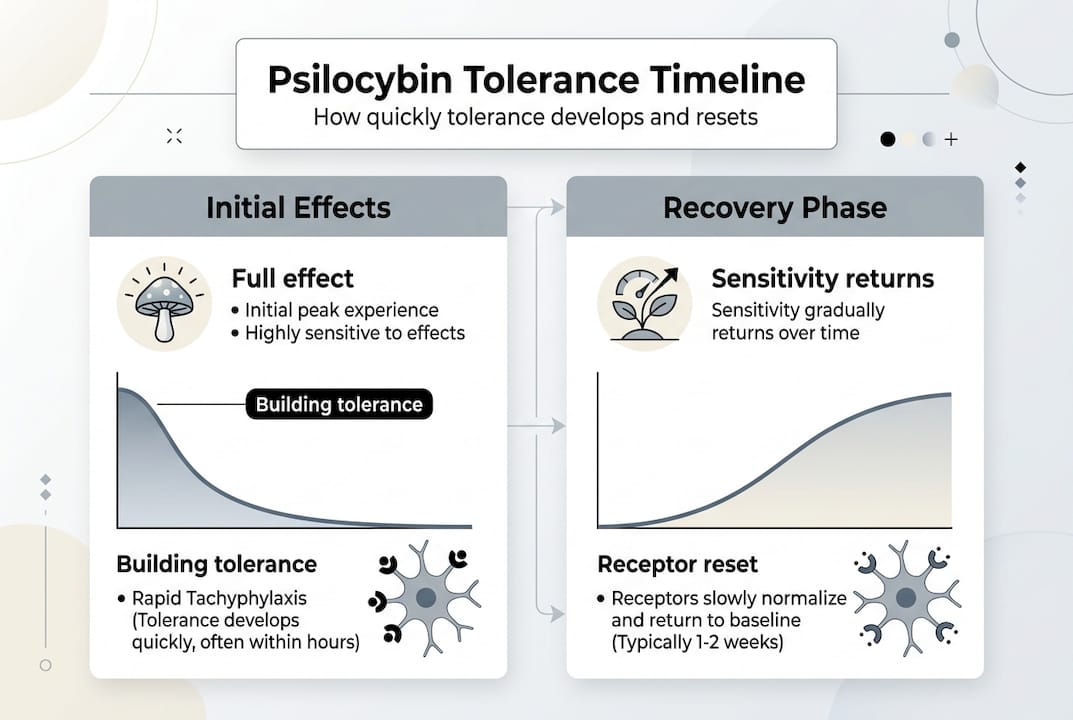
The speed is what surprises most people. Within hours of your first dose, receptor adaptation has already begun. By the next day, if you take the same dose again, you may feel 50% or less of the original effect. This is not a placebo issue or a mindset problem. It is receptor-level biology.

| Time after dose | Tolerance level | Expected effect |
|---|---|---|
| 0 to 6 hours | Building | Full effect from first dose |
| 24 hours | Moderate to high | 50% or less of original effect |
| 3 to 5 days | Moderate | Partial recovery |
| 7 days | Low to moderate | Significant recovery |
| 14 days | Near baseline | Full sensitivity mostly restored |
For microdosers, the timeline is more gradual but still real. Sub-perceptual doses do not trigger the same sharp receptor response as a full experience, but daily microdosing still builds tolerance over time, quietly eroding the mood and focus benefits you started for.
Therapeutic use follows a completely different logic. Clinical protocols space sessions weeks apart precisely because the goal is not just receptor activation but lasting neuroplasticity. Recreational frequent use sits at the opposite end of that spectrum, and the science does not support it for sustained results.
Pro Tip: If you are following a 3-day dosing strategy, you are already working with your receptor biology rather than against it. Pair this with the 2026 dosage guidelines to dial in amounts that stay effective over time.
Cross-tolerance: How psilocybin interacts with other psychedelics
If you have used psilocybin recently and then tried LSD, you may have noticed the effects felt blunted. That is cross-tolerance in action. Because psilocybin and LSD both work primarily through the 5-HT2A serotonin receptor, building tolerance to one reduces your sensitivity to the other.
Cross-tolerance exists between psilocybin and other serotonergic psychedelics, which has real implications for anyone alternating substances.
| Substance pair | Shared receptor | Cross-tolerance risk |
|---|---|---|
| Psilocybin + LSD | 5-HT2A | High |
| Psilocybin + DMT | 5-HT2A | Moderate to high |
| Psilocybin + mescaline | 5-HT2A | Moderate |
| Psilocybin + MDMA | Mixed (5-HT, dopamine) | Low to none |
Key points to understand about cross-tolerance:
- Switching from psilocybin to LSD does not reset your sensitivity
- Increasing the LSD dose to compensate does not reliably restore the full effect
- Alternating substances back-to-back diminishes the effect of both
- The only real reset is time, typically two or more weeks of abstinence
For a deeper look at how these two substances compare beyond tolerance, the psilocybin vs LSD breakdown covers the key differences in experience, duration, and use cases.
Microdosing and tolerance: Best practices for mental wellness
Microdosing works best when you treat it as a structured practice, not a daily supplement. The most common mistake is dosing every day because it feels manageable. Over days and weeks, the benefits quietly fade as receptor sensitivity drops, and many people assume the product stopped working rather than recognizing the tolerance pattern.
Here are the most effective protocols for preserving microdosing benefits:
- Fadiman protocol: 1 day on, 2 days off. This is the most widely used schedule and gives receptors consistent recovery time.
- 4 on, 3 off: Some users prefer a slightly longer active window, but the three off-days are non-negotiable for this to work.
- Intuitive dosing: Dose only when you feel you need support, with a minimum of two days between doses. Requires honest self-monitoring.
- Stamets protocol: 5 days on, 2 days off, often combined with lion’s mane and niacin. More aggressive and better suited to experienced users.
Intermittent schedules like 1 day on, 2 days off are specifically recommended to preserve the therapeutic benefits of microdosing over time.
“The off-days are not wasted days. They are when your receptors recover and your next dose earns its effect.”
Pro Tip: Before committing to any protocol, read through the full microdosing guide and the beginner’s guide to understand how dose size, strain, and schedule interact. The safe microdosing methods page also covers practical harm reduction steps.
Risks of ignoring tolerance: Adverse effects and safety insights
Ignoring tolerance does not just mean wasted doses. It can push people toward behaviors that carry real risk. When effects feel weaker, the instinct is often to take more. But escalating doses without understanding tolerance can lead to unexpectedly intense experiences, anxiety, or in rare cases, longer-lasting perceptual disturbances.
Key safety considerations:
- HPPD (Hallucinogen Persisting Perception Disorder): Rare, but repeated high doses without breaks increase the risk of prolonged visual disturbances
- Anxiety and overwhelm: Chasing a blunted effect with higher doses can produce experiences that feel unmanageable
- Contraindications: People with a personal or family history of schizophrenia or psychosis should avoid psilocybin entirely
- Lithium interaction: Combining psilocybin with lithium carries serious risk and should never be done
- Set and setting: Even with tolerance managed correctly, environment and mindset remain critical safety factors
“Psilocybin is non-addictive and produces no withdrawal, but that does not mean it is without risk when used carelessly.”
The absence of physical dependence is genuinely reassuring. You will not feel sick if you stop. But the psychological and perceptual risks of unstructured, high-frequency use are real enough to take seriously. For a grounded overview of responsible use, the therapeutic use of psilocybin page is a strong starting point.
Expert perspectives: Optimizing psilocybin therapy with tolerance in mind
The clinical research community has been clear on one point: spacing matters enormously for therapeutic outcomes. When sessions are too close together, tolerance blunts the experience and likely reduces the neuroplasticity benefits that make psilocybin therapy so promising for depression and anxiety.
Therapeutic macrodoses spaced 3 to 4 or more weeks apart are the current standard in clinical settings, and the reasoning is both neurological and psychological. The brain needs time to integrate the experience, and the receptors need time to recover.
Key expert insights shaping current practice:
- A single 25mg dose has shown effectiveness for depression with minimal concern for acute tolerance when sessions are properly spaced
- There is ongoing debate about whether the subjective psychedelic experience itself is necessary for mental health benefits, or whether receptor-level changes alone drive outcomes
- Most researchers agree that both the experience and the biology contribute, which is why set, setting, and spacing all matter
- Neuroplasticity windows appear to open after a session and remain elevated for days, making the post-dose period as important as the dose itself
For those planning a structured approach, the dosage workflow offers a practical framework for moving from intention to protocol to outcome.
Explore safe microdosing and wellness solutions
If this article has shifted how you think about psilocybin tolerance, the next step is building a protocol that actually holds up over time. Understanding the science is one thing. Applying it with the right tools, doses, and schedules is where real results come from.

At Fungal Friend, we have built our resources specifically for Canadian adults who want to approach microdosing with intention. The psilocybin microdosing guide walks you through dose ranges, timing, and what to expect at each stage. If you are just starting out, the beginner microdosing guide covers everything from strain selection to first-dose preparation. And for those who want to go deeper on harm reduction, the safe microdosing method page offers practical, evidence-informed guidance. Your protocol should work with your biology, not against it.
Frequently asked questions
Can I microdose psilocybin daily without building tolerance?
No. Daily intake reduces therapeutic benefits over time, and intermittent schedules with regular off-days are strongly recommended to keep effects consistent.
Is psychedelic tolerance the same as addiction?
No. Psilocybin produces tolerance through receptor adaptation but has no withdrawal or dependence associated with it, making it fundamentally different from addictive substances.
How long should I wait between psilocybin sessions to reset tolerance?
Basic sensitivity returns within two weeks, but spacing sessions 3 to 4 weeks apart is recommended for full receptor recovery and maximum therapeutic benefit.
Does tolerance to psilocybin affect other psychedelics?
Yes. Because psilocybin and LSD share the same primary receptor, cross-tolerance between them is well established, meaning recent psilocybin use will blunt the effects of LSD and vice versa.
Are there long-term risks to frequent psilocybin use?
While psilocybin is not physically addictive, repeated high doses without breaks can in rare cases lead to prolonged perceptual changes or persistent anxiety, which is why structured protocols matter.