
Psilocybin legal status in Canada: 301 approvals explained
TL;DR:
- Psilocybin remains illegal in Canada except through limited government exemptions.
- Only 301 Canadians secured legal access via special programs from 2022 to 2025.
- Penalties for possession and trafficking include imprisonment up to 10 years or more.
Only 301 Canadians received legal approval to access psilocybin through mid-2025. That number tells you everything about where Canada actually stands on psychedelic reform. While headlines often suggest a wave of legalization is coming, the reality for most Canadians is that psilocybin remains firmly illegal, tightly controlled, and accessible only through narrow, bureaucratic channels. This guide cuts through the noise. Whether you are a mental health seeker exploring therapeutic options or a microdosing enthusiast trying to understand what is and is not allowed, knowing the real legal landscape protects you from serious consequences.
Table of Contents
- Current legal classification of psilocybin in Canada
- Paths to legal access: Special Access Program and Section 56 exemptions
- Who qualifies for psilocybin: SAP, clinical trials, and limitations
- Risks, penalties, and gaps: What’s illegal, what’s changing?
- Why psilocybin’s legal status remains stuck and what most guides miss
- Navigating your psilocybin journey safely and legally
- Frequently asked questions
Key Takeaways
| Point | Details |
|---|---|
| Psilocybin remains illegal | Most Canadians cannot legally access psilocybin in 2025 except through narrow medical exemptions. |
| Limited legal channels | Special Access Program and Section 56 are the only legal routes for critical health cases, with low approval rates. |
| No personal use decriminalization | Microdosing and non-prescribed use of psilocybin is still fully criminalized with serious penalties. |
| Future changes remain uncertain | Court challenges may slowly expand access for professionals, but personal use reforms are not imminent. |
Current legal classification of psilocybin in Canada
Psilocybin is a Schedule III controlled substance under Canada’s Controlled Drugs and Substances Act (CDSA). That classification means producing, selling, possessing, or using psilocybin without explicit government authorization is a criminal offense. No exceptions exist for personal wellness use, spiritual practice, or self-guided microdosing. The law is clear, and enforcement is real.
For context, Schedule III sits one tier below Schedule I substances like heroin, but the legal consequences are still serious. Understanding the legal considerations for psilocybin in Canada means accepting that the framework was built for prohibition, not access.
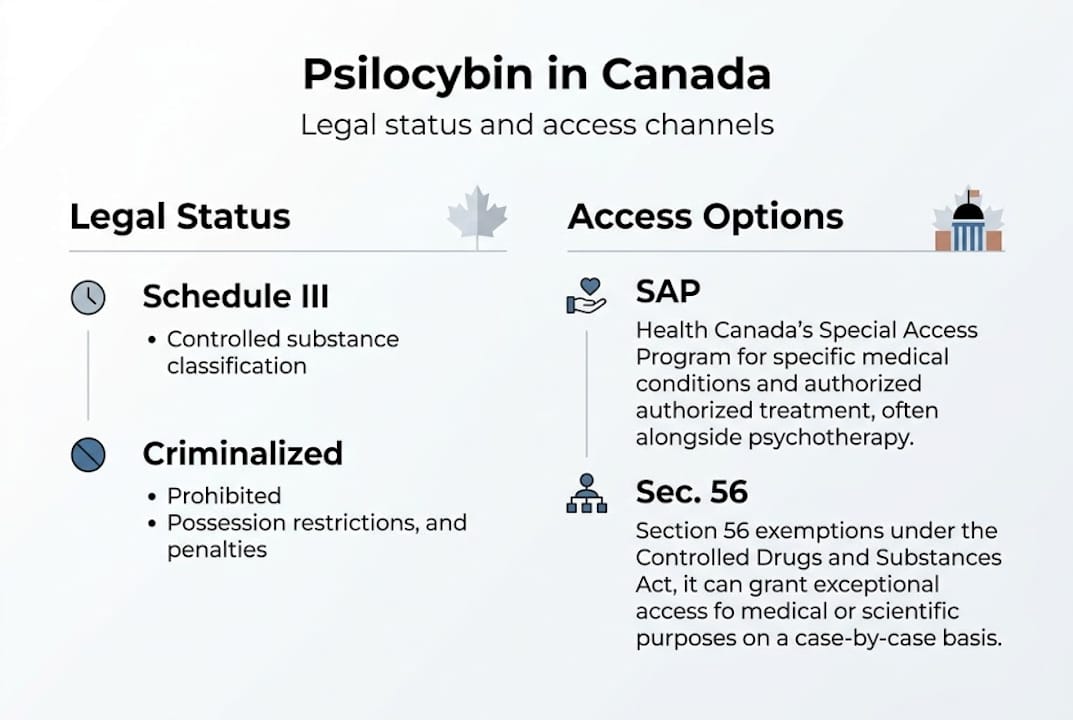
Health Canada has not approved any psilocybin-based therapeutic product for sale in Canada. There is no legal dispensary, no licensed retailer, and no prescription pathway that a doctor can simply write for you. The absence of an approved product means even the most well-intentioned therapeutic use falls outside the law.
| Legal status element | Detail |
|---|---|
| Scheduling | Schedule III under CDSA |
| Possession without authorization | Criminal offense |
| Maximum penalty (possession) | Up to 3 years imprisonment |
| Approved therapeutic products | None |
| Legal retail access | Not available |
| Authorized exemptions | Section 56 and SAP only |
The only legal pathways to psilocybin in Canada are Section 56 exemptions under the CDSA and the Special Access Program (SAP) administered by Health Canada. Both require formal applications, physician involvement, and government approval. Neither is available to the general public for personal use.
If you want a safe access guide that reflects current Canadian law, the starting point is accepting that no shortcut exists. The legal framework has not softened in any meaningful way for everyday Canadians, and that matters before you make any decisions.
Paths to legal access: Special Access Program and Section 56 exemptions
Two formal channels exist for Canadians who want to access psilocybin legally. Neither is simple, and neither is designed with the average wellness seeker in mind.
The Special Access Program (SAP) allows physicians to request access to unauthorized drugs for patients with serious or life-threatening conditions. For psilocybin, this typically means patients with terminal illness, severe treatment-resistant depression, or end-of-life anxiety. The physician submits the request, not the patient. Health Canada then reviews it and decides whether to grant access. Only 301 approvals were granted from 2022 through mid-2025, a number that reveals just how limited this pathway truly is.
Section 56 exemptions are different. They allow Health Canada to exempt specific individuals or groups from certain CDSA provisions for medical or scientific purposes. These exemptions have been used for healthcare professionals seeking training with psilocybin and for researchers running clinical studies. The approval rate since 2020 sits at just 16%, meaning most applications are rejected.
| Feature | SAP | Section 56 exemption |
|---|---|---|
| Who applies | Physician on behalf of patient | Individual or organization |
| Who qualifies | Serious/terminal illness patients | Researchers, healthcare professionals |
| Approval rate | Very low | ~16% since 2020 |
| Purpose | Compassionate therapeutic use | Training, research, special cases |
| Patient control | Minimal | Varies by exemption |
Statistic to know: Of all SAP requests for psilocybin submitted since the program opened access, only 301 resulted in approval by mid-2025. That is a vanishingly small number in a country of nearly 40 million people.

The Toth v. Canada court ruling added complexity by challenging whether blanket Section 56 denials for medical professionals were constitutional. That case may eventually widen access for practitioners, but it does not change anything for patients or personal users right now.
Pro Tip: If you or a loved one is pursuing SAP access, thorough documentation of failed conventional treatments and a physician willing to advocate strongly for the application significantly improve your odds. The process is bureaucratic and unpredictable, so preparation matters.
For a broader look at the 2025 rules and realities around psilocybin, understanding these two pathways is essential before exploring any other options.
Who qualifies for psilocybin: SAP, clinical trials, and limitations
The SAP was not designed for someone who wants to try psilocybin for general anxiety, burnout, or curiosity-driven microdosing. It was designed for people with nowhere else to turn medically. That distinction matters enormously.
Patients who have received SAP approval typically share a few characteristics. They have a serious or terminal diagnosis. They have tried and failed multiple conventional treatments. And they have a physician willing to go through the formal request process on their behalf. End-of-life distress and treatment-resistant depression are the most common qualifying situations, though edge cases like cluster headaches have occasionally succeeded through court orders rather than SAP itself.
Conditions most likely to support an SAP application:
- Terminal cancer with significant psychological distress
- Treatment-resistant major depressive disorder
- Post-traumatic stress disorder unresponsive to standard care
- End-of-life existential anxiety
- Severe obsessive-compulsive disorder with documented treatment failure
For microdosing enthusiasts, the picture is far less encouraging. There is no legal path for self-guided microdosing in Canada in 2025 or 2026. The only way to legally participate in microdosing research is through an approved clinical trial, and those are limited in scope and geography. One ongoing trial for anxiety microdosing is examining whether low doses can help people with anxiety, but enrollment is controlled and not open to the public on demand.
Most Canadians seeking mental health support through psilocybin face a stark reality: without a qualifying diagnosis, a supportive physician, and documented treatment failure, legal access is not available. The gap between public interest in psilocybin therapy and actual legal access remains enormous.
If you are exploring psilocybin for wellness purposes, reviewing a microdosing wellness guide and understanding microdosing safety information will help you make informed decisions about the risks you face under current law.
Risks, penalties, and gaps: What’s illegal, what’s changing?
Let’s be direct. Personal use, possession, and distribution of psilocybin remain fully criminalized across every Canadian province and territory. There is no gray zone for wellness use, no decriminalized city, and no province that has opted out of federal law on this issue.
The Controlled Drugs and Substances Act sets out the consequences clearly, and they are not minor.
Penalties for psilocybin-related offenses in Canada:
- Simple possession: Up to 3 years imprisonment and a criminal record
- Possession for the purpose of trafficking: Up to 10 years imprisonment
- Production or cultivation: Up to 10 years imprisonment
- Trafficking or distribution: Up to 10 years imprisonment
- Importing or exporting: Up to life imprisonment in the most serious cases
These are not theoretical maximums. Canadian courts have applied them. A criminal record for drug possession can affect employment, travel, and housing in ways that follow you for decades.
On the reform front, the picture is slower than many expect. Court rulings like Toth v. Canada are gradually reshaping how Section 56 exemptions are handled for medical professionals, but they do not touch public access. No federal legislation to decriminalize or regulate psilocybin for personal use has advanced meaningfully. Watching microdosing trends in 2025 shows growing public interest, but interest does not equal legality.
Pro Tip: Be skeptical of any product marketed as a legal psilocybin alternative for wellness in Canada. Many so-called gray-area products make misleading claims. Understanding why legality matters before purchasing anything protects both your health and your legal standing.
Why psilocybin’s legal status remains stuck and what most guides miss
Here is the uncomfortable truth that most psilocybin guides skip over: Canada’s regulatory caution is not irrational, and it is not going away quickly.
Policymakers watched cannabis legalization unfold with years of infrastructure challenges, enforcement inconsistencies, and public health debates. Psilocybin adds another layer of complexity because the therapeutic evidence, while promising, is still being built. Regulators are genuinely uncertain about how to supervise use, set dosing standards, and prevent harm outside clinical settings. That uncertainty slows everything.
Mainstream coverage of psychedelic reform tends to highlight the exciting studies and the growing number of exemptions, while quietly glossing over how rare legal access remains. Exploring the legal landscape for psychedelics in Canada reveals that even legitimate health seekers face prohibitive barriers. The 301 SAP approvals over three years is not a sign of momentum. It is a sign of how narrow the gate actually is.
Our honest advice: plan as though the law will remain unchanged through at least 2027. If reform comes sooner, great. But making decisions based on expected legalization that has not arrived yet is how people end up with criminal records.
Navigating your psilocybin journey safely and legally
For Canadians who want to explore psilocybin thoughtfully, education is the most important first step. Knowing what the law actually says, what the real risks are, and what responsible use looks like keeps you informed and protected.
At Fungal Friend, we believe that responsible exploration starts with accurate information. Our microdosing guide for wellness covers what microdosing actually involves, how people approach it, and what to consider before starting. For those focused on safety, our dosage guidelines for safe microdosing break down the numbers without the guesswork. And if you are just getting started, our beginner’s microdosing guide is the clearest place to begin. We are here to help you navigate this space with your eyes open.
Frequently asked questions
Is psilocybin legal for microdosing in Canada in 2025?
No, microdosing remains illegal for personal or wellness use in Canada as of 2025. The only legal microdosing activity occurs within approved clinical trials with controlled enrollment.
How can someone access psilocybin legally in Canada?
Legal access is possible only through Health Canada’s Special Access Program, Section 56 exemptions, or approved clinical trials. Each pathway requires physician involvement and formal approval from Health Canada for specific qualifying conditions.
Has psilocybin been decriminalized in any Canadian province in 2025?
No, psilocybin has not been decriminalized in any province or territory in Canada as of 2025. Federal law applies uniformly, and penalties remain in force across the country.
What are the penalties for possessing psilocybin in 2025?
Possessing psilocybin without authorization can result in criminal charges with penalties up to three years of imprisonment, plus a permanent criminal record that affects employment and travel.
Does having a mental health diagnosis guarantee SAP approval for psilocybin?
No, a diagnosis alone is not enough. SAP approvals require documented proof that conventional treatments have failed and active physician support. Most applications are denied even with qualifying conditions.