
Psilocybin vs alcohol: safety and mental wellness compared
TL;DR:
- Psilocybin promotes lasting brain growth and positive mood changes, unlike alcohol which damages neural pathways.
- Alcohol has high dependency risks and long-term mental health drawbacks, whereas psilocybin is generally non-addictive.
- In Canada, alcohol is legal and accessible, while psilocybin is restricted to therapeutic and research use under regulated programs.
Alcohol is deeply woven into Canadian social life, yet most people never question whether it actually helps their mental health or just feels like it does. Psilocybin sits at the opposite end of the cultural spectrum, still largely misunderstood and legally restricted, yet backed by a growing body of research suggesting it may offer real, lasting benefits for mood and wellbeing. These two substances are not equally risky or equally beneficial, and treating them as comparable options is a mistake that costs people real wellness outcomes. This guide breaks down the neuroscience, safety data, therapeutic evidence, and legal realities so you can make an informed choice.
Table of Contents
- How psilocybin and alcohol affect the brain and mood
- Safety, risks, and dependency: what Canadians need to know
- Therapeutic potential: what does the evidence show?
- Legal status and practical access in Canada
- Why relying on alcohol for wellness is outdated and what most people miss about psilocybin
- Explore safe, science-backed psilocybin options for wellness
- Frequently asked questions
Key Takeaways
| Point | Details |
|---|---|
| Psilocybin drives brain growth | Psilocybin promotes neuroplasticity and long-term wellness benefits not seen with alcohol. |
| Alcohol carries addiction risk | Alcohol is associated with dependence, brain shrinkage, and worsened mental health outcomes. |
| Therapy boosts psilocybin results | When integrated with psychotherapy, psilocybin can significantly improve addiction and mood disorders. |
| Legal access favors alcohol | Alcohol is legal and easily accessed in Canada, while psilocybin remains tightly regulated. |
| Informed choice is essential | Understanding risks, evidence, and safety empowers Canadians to make wise wellness decisions. |
How psilocybin and alcohol affect the brain and mood
To compare these two substances fairly, you need to understand what they actually do inside your brain, not just how they make you feel in the moment.
Psilocybin works primarily as a 5-HT2A serotonin receptor agonist, meaning it activates serotonin receptors in ways that trigger structural neuroplasticity. Neuroplasticity is your brain’s ability to form new connections and reorganize itself. When psilocybin activates these pathways, it can literally grow new synaptic connections, which is why researchers see lasting behavioral and mood changes even after a single dose. This is not a temporary chemical lift. It is a structural shift in how your brain operates.
Alcohol works very differently. It boosts GABA (a calming neurotransmitter) and suppresses glutamate (an excitatory one), while also triggering a dopamine release that creates that familiar sense of relaxation and reward. The short-term mood boost is real, but the long-term picture is far less appealing. Repeated alcohol use damages neural pathways, disrupts neuroplasticity, and is strongly linked to increased rates of anxiety and depression over time.
Here is a side-by-side look at how each substance affects the brain:
| Feature | Psilocybin | Alcohol |
|---|---|---|
| Primary mechanism | Serotonin (5-HT2A) agonist | GABA boost, glutamate suppression |
| Short-term mood effect | Emotional openness, insight | Relaxation, reduced inhibition |
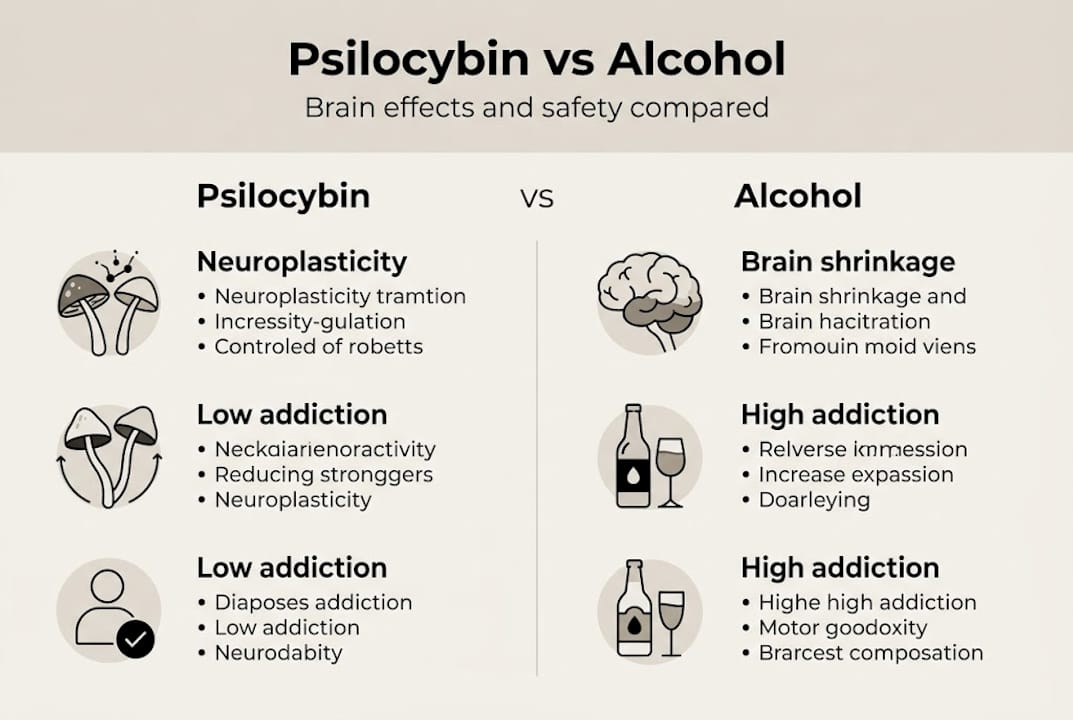
| Long-term brain impact | Increased synaptic connections | Brain volume reduction |
| Neuroplasticity | Promotes growth | Disrupts and damages |
| Dependency risk | Very low | High |
The contrast is stark. While alcohol shrinks brain volume with chronic use, psilocybin is linked to the opposite effect. Understanding psilocybin and mental health at this neurological level helps explain why researchers are so excited about its therapeutic potential.
Key mood-related differences to keep in mind:
- Psilocybin can produce lasting positive mood changes after even one or two guided sessions
- Alcohol’s mood boost fades quickly and often leads to rebound anxiety
- Psilocybin supports emotional processing and cognitive flexibility
- Alcohol numbs emotional processing and impairs decision-making
Pro Tip: If you are using alcohol to unwind after a stressful week, you are borrowing calm from tomorrow. Psilocybin, used responsibly and in the right context, may offer a path to genuine mood regulation rather than temporary suppression.
Safety, risks, and dependency: what Canadians need to know
Understanding the science is just one side. The real-world safety differences matter even more when you are making decisions about your own health.
Alcohol carries one of the highest dependency risks of any widely used substance. Tolerance builds quickly, meaning you need more to get the same effect. Withdrawal from alcohol can be medically dangerous, even life-threatening in severe cases. Beyond physical dependency, alcohol use disorder is strongly associated with worsening depression, anxiety, and cognitive decline over time.

Psilocybin presents a very different safety profile. It is not physically addictive. You cannot build the kind of tolerance that drives compulsive use. However, it is not without risks. Psilocybin is not appropriate for people with a personal or family history of psychosis or schizophrenia, as it can trigger or worsen psychotic episodes in vulnerable individuals.
Here is a direct comparison of safety considerations:
| Risk factor | Psilocybin | Alcohol |
|---|---|---|
| Physical addiction | None | High risk |
| Psychological distress | Possible in vulnerable users | Common with chronic use |
| Withdrawal danger | None | Potentially life-threatening |
| Long-term mental health | Positive in clinical settings | Negative with regular use |
| Overdose risk | Extremely low | Significant |
Who should avoid psilocybin:
- People with personal or family history of psychosis or schizophrenia
- Individuals on SSRIs or lithium (drug interactions possible)
- Those with severe cardiovascular conditions
- Pregnant or breastfeeding individuals
Who should reconsider alcohol for wellness:
- Anyone with a family history of alcohol dependence
- People already managing anxiety or depression
- Those on medications that interact with alcohol
“The burden of alcohol use disorder in Canada is enormous, affecting not just individuals but families and healthcare systems. The search for safer alternatives is not fringe thinking. It is a public health priority.”
For a deeper look at how to approach this responsibly, the psilocybin risks and benefits guide and mushroom safety guidelines are solid starting points before making any decisions.
Pro Tip: Never combine psilocybin with alcohol or other substances without professional guidance. The interaction can unpredictably intensify psychological effects and reduce safety.
Therapeutic potential: what does the evidence show?
But how do these substances actually stack up when it comes to treating real health challenges?
The research on psilocybin-assisted therapy has accelerated dramatically over the past decade. Systematic reviews now show that psilocybin-assisted psychotherapy meaningfully reduces alcohol consumption, cuts the number of heavy drinking days, and increases abstinence rates in people with alcohol use disorder. These are not minor improvements. They represent outcomes that conventional treatments often fail to achieve.
For context, standard medication-based treatments for alcohol use disorder, such as naltrexone, produce roughly 15 to 25% one-year abstinence rates. Psilocybin-assisted therapy in early trials has outperformed these benchmarks, particularly when paired with structured psychotherapy. The combination appears to be key. Psilocybin alone is not the answer. Integration with professional therapeutic support is what drives lasting results.
The evidence is strongest in these areas:
- Reducing alcohol consumption in people with alcohol use disorder
- Supporting smoking cessation
- Improving mood and reducing depression symptoms
- Decreasing end-of-life anxiety in terminal illness patients
How to think about the evidence as a Canadian:
- Most trials are still relatively small and often open-label (meaning participants know what they are taking), which limits certainty
- The strongest results come from supervised, therapy-integrated settings, not casual use
- Results from NYU and Johns Hopkins randomized controlled trials are genuinely promising
- A 2025 Swiss trial found psilocybin did not prevent relapse without additional support, reinforcing that context matters
“Psilocybin is not a replacement for therapy. It is a catalyst that, in the right setting, can make therapy work better.”
Experts remain divided. Contrasting views on efficacy persist due to trial quality differences, but the overall direction of evidence is positive. If you are curious about psilocybin for alcoholism or how it compares to standard treatments, the research landscape is worth exploring carefully.
Legal status and practical access in Canada
The science only matters if you can actually use the substance safely and legally. Here is what Canadians should know in 2026.
Alcohol is fully legal, widely available, and heavily marketed. You can buy it in most provinces at a grocery store. That accessibility, however, comes with enormous societal costs including healthcare burden, impaired driving fatalities, and widespread addiction.
Psilocybin is a Schedule III controlled substance in Canada. Regulated access is limited to specific therapeutic and research programs. Health Canada’s Special Access Program allows some patients to access psilocybin-assisted therapy through licensed practitioners, but this is not broadly available to the general public.
How each substance can currently be obtained and used:
- Alcohol: Legal for adults, sold through licensed retailers, no medical supervision required
- Psilocybin (therapeutic): Accessible via Health Canada’s Special Access Program with a licensed practitioner
- Psilocybin (research): Available through approved clinical trials at select institutions
- Psilocybin (unregulated): Illegal for personal use outside authorized programs
What Canadians should keep in mind:
- Purchasing psilocybin from unregulated sources carries legal risk
- The regulatory landscape is shifting, with growing advocacy for broader therapeutic access
- Staying informed about psilocybin legal trends helps you understand where access may expand
- Understanding Canadian psilocybin safety guidelines protects you regardless of how you access information
The gap between what the science says and what the law currently allows is real. But that gap is narrowing, and being informed positions you to make better decisions as the landscape evolves.
Why relying on alcohol for wellness is outdated and what most people miss about psilocybin
Alcohol has been normalized as a social lubricant and stress reliever for so long that most people never question whether it actually works for mental wellness. It does not. The short-term relief it provides masks a long-term cost that shows up as worsened anxiety, disrupted sleep, and reduced emotional resilience. The cultural acceptance of alcohol for mood management is not evidence of effectiveness. It is evidence of habit.
Psilocybin deserves serious attention, but not blind enthusiasm. The research trends in 2026 are genuinely exciting, but the evidence is clearest when psilocybin is used in structured, supported settings. Replacing one substance with another without understanding the context, the risks, and the proper approach is not wellness. It is just a different kind of avoidance.
What most Canadians miss is that psilocybin’s real value is not in the experience itself. It is in what the experience enables: new perspectives, emotional processing, and a brain that is more capable of change. That is fundamentally different from what alcohol offers, and it is worth understanding that difference before making any choices.
Explore safe, science-backed psilocybin options for wellness
If you are considering taking the next step toward natural wellness with psilocybin, education comes first. Understanding how psilocybin works, what doses are appropriate, and how to approach it safely makes all the difference between a meaningful experience and an overwhelming one.
At Fungal Friend, we have built our platform around exactly that kind of informed approach. Whether you are just starting out or looking to deepen your understanding, our psilocybin microdosing guide walks you through the fundamentals clearly. For those ready to understand specific amounts, the psilocybin dosage guidelines offer practical, safety-focused direction. And if you are brand new to this space, our beginner microdosing guide is the right place to start.
Frequently asked questions
Is psilocybin safer than alcohol for mental health?
Evidence shows psilocybin has lower addiction potential and does not cause brain shrinkage like alcohol does, but psilocybin carries real risks for people with certain mental health histories and is not suitable for everyone.
Can psilocybin help people stop drinking alcohol?
Psilocybin-assisted therapy has been shown in multiple trials to reduce alcohol consumption and increase abstinence rates, particularly when combined with structured psychotherapy support.
Who should avoid psilocybin or alcohol?
Anyone with a personal or family history of psychosis, schizophrenia, or severe alcohol dependence should avoid both substances and speak with a physician before considering either for wellness purposes.
Is psilocybin legal in Canada for personal use?
Psilocybin remains a controlled substance in Canada and is not legal for personal use outside of Health Canada’s Special Access Program or approved clinical research settings.
How does psilocybin’s effect feel compared to alcohol?
Psilocybin tends to produce emotional openness, perceptual shifts, and lasting insight, while alcohol creates short-term relaxation followed by cognitive impairment. Psilocybin disrupts the default mode network and promotes neuroplasticity, whereas alcohol reinforces craving cycles and impairs cognition over time.