
Education’s role in psychedelics for Canadian adults 2026
You’ve heard psychedelics can transform mental wellness, boost creativity, and unlock hidden potential. But here’s the catch: a common misconception is that psychedelics are universally beneficial, which ignores the critical reality that individual responses vary dramatically. Without proper education, you risk navigating this complex landscape blindly, potentially facing adverse reactions, legal issues, or ineffective outcomes. This article explores how education empowers Canadian adults to approach psychedelics, especially microdosing, with the knowledge needed for safe, responsible, and mentally beneficial experiences in 2026.
Table of Contents
- Understanding Psychedelics And The Need For Education
- How Education Shapes Safe Psychedelic Use And Harm Reduction
- Educational Resources And Comparisons For Safe Psychedelic Exploration
- Applying Education: Responsible Microdosing For Mental Wellness
- Explore Fungal Friend’s Educational Guides And Products
- Frequently Asked Questions
Key takeaways
| Point | Details |
|---|---|
| Individual variability matters | Psychedelic responses differ significantly between people based on biology, mental health, and environment. |
| Education reduces harm | Informed users understand dosing, setting, and contraindications, minimizing risks and maximizing benefits. |
| Responsible microdosing requires knowledge | Safe mental wellness outcomes depend on understanding protocols, legal status, and personal assessment. |
| Ongoing learning is essential | Psychedelic science evolves rapidly, making continuous education critical for up-to-date, safe practices. |
Understanding psychedelics and the need for education
Psychedelics are substances that alter perception, mood, and cognition, with psilocybin (found in magic mushrooms) being among the most studied and popular. These compounds interact with serotonin receptors in your brain, creating experiences that range from subtle mood shifts to profound consciousness expansion. For Canadian adults in 2026, interest centers increasingly on microdosing: taking sub-perceptual doses (typically 0.1 to 0.3 grams of dried psilocybin mushrooms) to support mental wellness without inducing full psychedelic effects.
Microdosing has gained traction for reported benefits like reduced anxiety, enhanced focus, improved mood balance, and creative thinking. However, what are psychedelics and how they work remains poorly understood by many newcomers. This knowledge gap creates risk.
The dangerous assumption that psychedelics work the same for everyone ignores biological reality. Your genetics, current medications, mental health history, and even gut microbiome influence how psilocybin affects you. Someone with undiagnosed bipolar disorder might experience mania. Another person on SSRIs could face reduced effects or serotonin syndrome. Without education, you can’t recognize these variables or adjust accordingly.
Education fills this gap by providing:
- Clear understanding of psychedelic mechanisms and effects
- Accurate dosing information tailored to individual goals
- Awareness of legal status and regulations in Canada
- Recognition of contraindications and risk factors
- Frameworks for assessing personal readiness and safety
In 2026, as psychedelic interest grows, the gap between enthusiasm and knowledge widens. Education bridges that divide, transforming curiosity into competent, safe exploration.
How education shapes safe psychedelic use and harm reduction
Harm reduction isn’t about eliminating all risk; it’s about minimizing negative outcomes while respecting individual autonomy. This philosophy recognizes that people will use psychedelics regardless of warnings, so providing accurate information saves lives and improves experiences. Education emphasizes that individual responses vary and that responsible use requires careful consideration of personal circumstances and potential risks, creating a foundation for smart decision making.
Key educational messages for psychedelic harm reduction safe microdosing Canada include:
- Dosing accuracy: Understanding that 0.1 grams versus 0.5 grams creates vastly different experiences, and that mushroom potency varies by strain and growing conditions
- Set and setting: Recognizing how your mindset and environment profoundly influence outcomes, especially for higher doses
- Mental health screening: Identifying contraindications like schizophrenia, bipolar disorder, or severe anxiety that require professional guidance
- Drug interactions: Knowing which medications (SSRIs, MAOIs, lithium) interact dangerously with psilocybin
- Integration practices: Learning how to process and apply insights from psychedelic experiences constructively
Common risks that education directly mitigates include psychological distress from overwhelming experiences, physical dangers from impaired judgment, legal consequences from possession in restricted contexts, and wasted potential from improper dosing or preparation. When you understand these risks beforehand, you can implement safeguards: starting with minimal doses, having a trusted sober person present for higher doses, researching safe psychedelic use Canada legal boundaries, and maintaining a journal to track effects.

Pro Tip: Before your first microdose, spend at least two weeks researching protocols, reading user experiences, and honestly assessing your mental health history. Consult reliable sources like peer-reviewed studies, established psychedelic education organizations, and healthcare providers familiar with psychedelics. This preparation dramatically improves safety and outcomes.
Education transforms psychedelics from a gamble into an informed choice. You learn to recognize warning signs, adjust protocols based on your unique response, and build a sustainable practice that genuinely supports mental wellness rather than creating new problems.
Educational resources and comparisons for safe psychedelic exploration
Navigating psychedelic information requires discernment. The internet overflows with content ranging from rigorous scientific research to dangerous misinformation. Understanding which resources deserve your trust makes the difference between safe exploration and preventable harm.
| Resource Type | Strengths | Limitations | Best For |
|---|---|---|---|
| Peer-reviewed research | Scientifically validated, rigorous methodology | Often technical, slow to publish new findings | Understanding mechanisms and clinical evidence |
| Psychedelic therapy guides | Professional clinical context, integration support | Expensive, limited availability in Canada | Therapeutic applications and mental health conditions |
| Online safety protocols | Accessible, practical, regularly updated | Variable quality, lacks personalization | Harm reduction basics and dosing guidelines |
| Community forums | Real user experiences, diverse perspectives | Anecdotal, potential misinformation, bias | Understanding subjective effects and troubleshooting |
Different information types serve distinct purposes. Psychedelic therapy science benefits risks academic research provides foundational understanding but rarely offers practical protocols. Professional therapy integrates clinical expertise but costs hundreds per session and remains scarce outside major cities. Online guides like magic mushroom safety guidelines deliver actionable steps but can’t account for your specific health profile. Peer education through experienced users offers relatable insights but lacks scientific rigor.
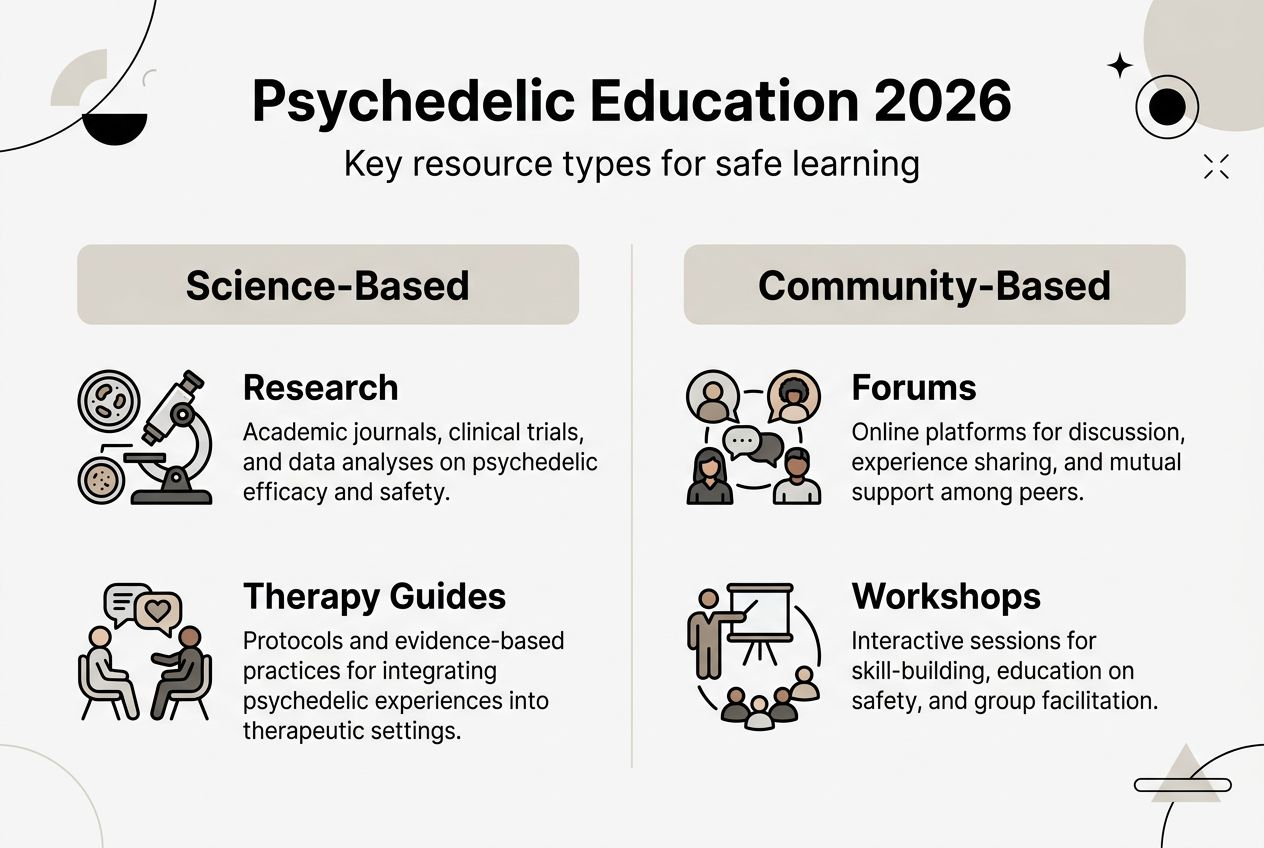
The smartest approach combines multiple sources, cross-referencing information to identify consensus and flag contradictions. Education supports individuals to understand and weigh potential risks of psychedelics by providing frameworks to evaluate claims critically.
Criteria for evaluating psychedelic education quality:
- Author credentials and expertise in psychedelic science or clinical practice
- Citation of peer-reviewed research and transparent methodology
- Acknowledgment of limitations, risks, and individual variability
- Regular updates reflecting current science and legal landscape
- Absence of financial conflicts of interest or product promotion within educational content
- Clear distinction between evidence-based facts and anecdotal reports
Pro Tip: Bookmark three to five trusted educational resources and revisit them quarterly. Psychedelic research advances rapidly, with new studies on microdosing efficacy, optimal protocols, and long-term safety emerging regularly. Staying current ensures your practice reflects the latest evidence rather than outdated assumptions.
Building your educational foundation takes time but pays dividends in safety, effectiveness, and confidence. You’ll recognize red flags in questionable advice, make informed adjustments to your protocol, and approach psychedelics with appropriate respect and preparation.
Applying education: responsible microdosing for mental wellness
Knowledge without application remains theoretical. Translating psychedelic education into practical microdosing requires systematic steps that prioritize safety while pursuing mental wellness benefits. Responsible use requires careful consideration of personal circumstances and potential risks, making individual assessment the critical first step.
Follow this evidence-informed protocol for beginner microdosing guide safe psilocybin implementation:
-
Conduct honest self-assessment: Review your mental health history, current medications, and family psychiatric background. Identify any contraindications like bipolar disorder, schizophrenia, or pregnancy. If concerns exist, consult a healthcare provider before proceeding.
-
Research legal status: In Canada 2026, understand current regulations around psilocybin possession and use in your province. Legal landscapes shift, and staying informed protects you from unintended consequences.
-
Source quality product: Obtain psilocybin from reliable sources with consistent potency. Variability in mushroom strength makes dosing unpredictable, undermining safety and effectiveness.
-
Start extremely low: Begin with 0.05 to 0.1 grams of dried psilocybin mushrooms, well below typical microdose ranges. This test dose reveals your individual sensitivity without risking overwhelming effects.
-
Follow a structured schedule: Common protocols include one day on, two days off (Fadiman protocol) or four days on, three days off. Consistency enables accurate tracking of effects and prevents tolerance buildup.
-
Maintain detailed records: Journal your dose, timing, mood, focus, sleep quality, and any notable experiences. Patterns emerge over weeks, revealing optimal dosing and scheduling for your unique biology.
-
Adjust methodically: After two to four weeks, evaluate your journal data. If effects are too subtle, increase dose by 0.025 to 0.05 grams. If you notice mild perceptual changes, reduce slightly. Psilocybin dosage guidelines 2026 safe microdosing emphasize gradual titration.
-
Plan integration practices: Combine microdosing with meditation, therapy, journaling, or creative activities that help process insights and support mental wellness goals.
-
Take regular breaks: Every eight to twelve weeks, pause microdosing for two to four weeks. This reset prevents tolerance, allows objective assessment of benefits, and ensures you’re not masking underlying issues requiring different interventions.
-
Reassess continuously: Mental health, life circumstances, and goals evolve. Regularly evaluate whether microdosing still serves your wellness objectives or whether adjustments or discontinuation make sense.
This systematic approach transforms education into lived experience. You develop personal expertise about how psilocybin affects your unique biology, what dosing optimizes benefits without side effects, and how to integrate microdosing sustainably into your mental wellness toolkit. Education provides the map; methodical application reveals your specific path.
Explore Fungal Friend’s educational guides and products
Applying psychedelic education safely requires both knowledge and access to quality products designed for responsible use. Fungal Friend combines comprehensive educational resources with carefully curated psilocybin offerings, supporting Canadian adults pursuing mental wellness through informed microdosing practices.
Our beginner microdosing guide walks you through every step of safe psilocybin exploration, from initial self-assessment to long-term protocol optimization. We’ve distilled complex research into actionable frameworks that respect individual variability while prioritizing harm reduction. Complement this with our psilocybin dosage guidelines 2026 safe microdosing resource, offering strain-specific recommendations and adjustment strategies based on your goals and responses.
For convenient, consistent microdosing, our microdose mushroom capsules deliver precisely measured psilocybin in discreet, easy-to-use formats. Each capsule contains standardized dosing, eliminating the guesswork that compromises safety and effectiveness. Whether you’re targeting anxiety reduction, focus enhancement, or mood balance, our product selection supports your specific mental wellness intentions with quality you can trust. Explore Fungal Friend today and transform education into empowered, responsible psychedelic practice.
Frequently asked questions
What role does education play in safe psychedelic use?
Education provides the knowledge foundation for recognizing individual variability, understanding proper dosing, identifying contraindications, and implementing harm reduction strategies. Without this information, users risk adverse reactions, legal issues, and ineffective outcomes that undermine mental wellness goals. Informed decision making transforms psychedelics from risky experimentation into purposeful, safe psychedelic use Canada practice.
How does education improve mental wellness outcomes with microdosing?
Educated microdosers understand how to assess personal readiness, select appropriate doses, track effects systematically, and adjust protocols based on individual response. This knowledge enables optimization of benefits like reduced anxiety and enhanced focus while minimizing side effects. Education also teaches integration practices that help translate psychedelic insights into lasting behavioral and cognitive improvements supporting overall mental health.
What are the most important safety considerations for psychedelic beginners?
Beginners must screen for mental health contraindications (bipolar disorder, schizophrenia, severe anxiety), understand drug interactions with current medications, start with minimal doses to assess individual sensitivity, and research legal status in their location. Setting and mindset preparation, having trusted support available, and maintaining detailed records of experiences also prove critical for safe, beneficial outcomes.
Can education help prevent negative psychedelic experiences?
While education cannot eliminate all risk, it dramatically reduces likelihood of negative outcomes by teaching proper dosing, set and setting optimization, contraindication recognition, and crisis management strategies. Educated users know how to create supportive environments, start conservatively, and respond effectively if experiences become challenging. This preparation transforms potential crises into manageable situations.
Where can Canadians find reliable psychedelic education in 2026?
Reliable sources include peer-reviewed research databases, established psychedelic education organizations with scientific advisory boards, healthcare providers specializing in psychedelic medicine, and evidence-based online resources that cite research and acknowledge limitations. Cross-referencing multiple trusted sources helps identify consensus while filtering misinformation. Regular updates ensure information reflects current science and legal landscapes.
How often should I update my psychedelic knowledge?
Revisit trusted educational resources quarterly, as psychedelic research advances rapidly with new findings on efficacy, safety, optimal protocols, and legal status. Before making significant changes to your microdosing practice, research current evidence. Annual comprehensive reviews of your educational foundation ensure your approach remains evidence-based and aligned with evolving scientific understanding and regulatory environments.