
Why psychedelic education matters for Canadian wellness
TL;DR:
- Growing interest in psychedelics for mental health in Canada is outpacing available education and regulation.
- Proper education on science, safety, and legality is essential for harm reduction and safe use.
- Evidence shows benefits for depression and anxiety, but long-term safety and risks require informed caution.
Interest in psychedelics for mental well-being is growing fast across Canada, but the guidance available to everyday users has not kept pace. Canadians are turning to psilocybin, microdosing protocols, and related substances to manage anxiety, depression, and burnout, often without reliable information to guide them. The gap between public enthusiasm and clinical knowledge creates real risks. Education on psychedelics is now considered essential for harm reduction as interest outpaces both regulation and medical training. This guide covers the landscape, the science, the legal reality, and the practical steps you need to use psychedelics safely and wisely.
Table of Contents
- The rise of psychedelics for mental health in Canada
- What psychedelic education covers: Science, safety, and legality
- Benefits and risks of psychedelics: Evidence vs. hype
- Practical education: How Canadians can stay safe and informed
- Why education is the missing link for safe psychedelic use in Canada
- Explore safe guides and products for microdosing in Canada
- Frequently asked questions
Key Takeaways
| Point | Details |
|---|---|
| Education prevents harm | Understanding science, safety, and legality helps Canadians avoid major risks with psychedelics. |
| Evidence guides wellness | Empirical data supports benefits for mood and anxiety, but always consult medical professionals and rely on trustworthy sources. |
| Legal status matters | Psilocybin and other psychedelics remain restricted in Canada except through clinical trials or special programs. |
| Practical steps are key | Precise dosing, lab-tested products, and medical consultation are crucial for safe microdosing and psychedelic use. |
The rise of psychedelics for mental health in Canada
Something has shifted in how Canadians talk about mental health. Prescription medications and traditional therapy remain the standard, but a growing number of people are looking beyond them. Psilocybin mushrooms, microdosing routines, and psychedelic-assisted approaches have moved from fringe conversations into mainstream wellness culture. The reasons are not hard to understand. Conventional treatments do not work for everyone, wait times for mental health services are long, and word-of-mouth stories about psychedelic experiences are compelling.
Microdosing, in particular, has attracted serious attention. Taking sub-perceptual doses of psilocybin on a regular schedule appeals to people who want mood and focus benefits without a full psychedelic experience. Interest spans a wide range of Canadians: professionals managing stress, people recovering from burnout, and those dealing with persistent anxiety or depression who feel stuck.
Here is what is driving this trend:
- Gaps in conventional care: Many Canadians report that antidepressants blunt emotion or carry side effects that feel worse than the original problem.
- Growing research coverage: Media coverage of clinical trials has made psilocybin feel more credible and accessible.
- Community and social proof: Online communities, podcasts, and peer networks have normalized microdosing conversations.
- Desire for natural alternatives: Health-conscious consumers are drawn to plant-based and fungi-based approaches over pharmaceutical options.
The problem is that public interest has outpaced clinical knowledge and regulation in Canada, leaving users to piece together information from unreliable sources. Unregulated products carry contamination risks. Misinformation spreads quickly. Without a solid foundation in education’s role in psychedelics, even well-intentioned users can make choices that backfire. Microdosing mental health research is promising but still evolving, which makes knowing how to read and apply that research a skill worth building. A good psychedelic harm reduction guide is not optional. It is the baseline for anyone serious about this space.
What psychedelic education covers: Science, safety, and legality
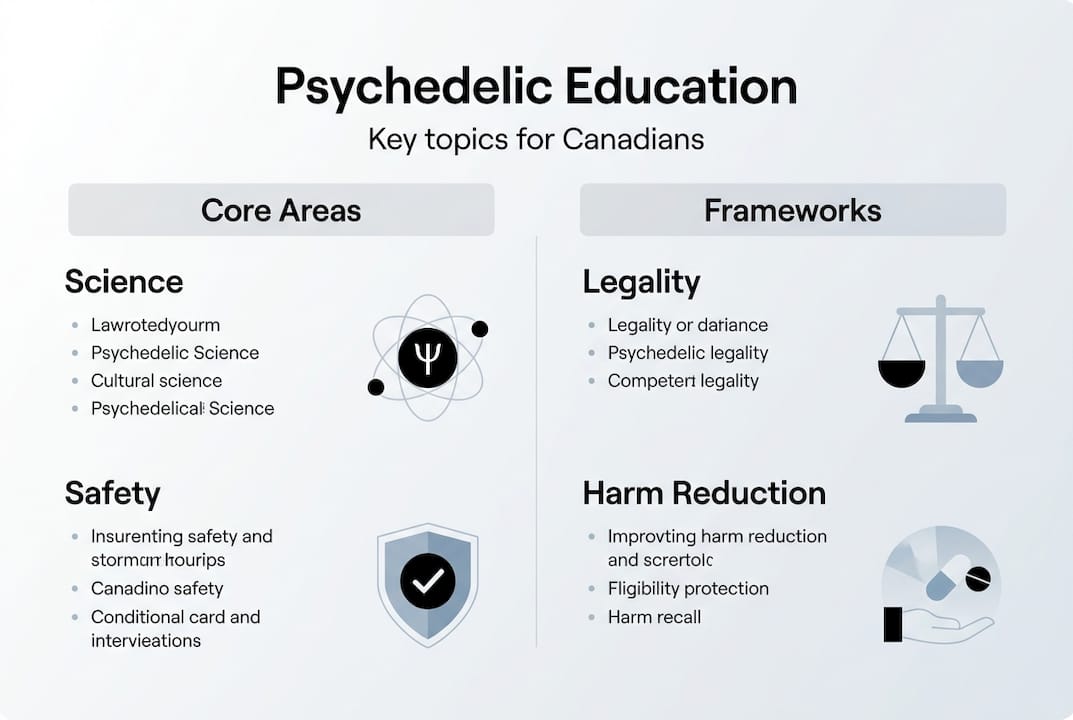
Proper psychedelic education is not just reading a few Reddit threads or watching a documentary. It covers four distinct areas, each of which matters for a different reason.
1. The science of how psychedelics work
Psilocybin converts to psilocin in the body and binds to serotonin receptors, particularly 5-HT2A receptors in the brain. This produces changes in perception, cognition, and mood. Understanding the basic mechanism helps users set realistic expectations and recognize when something unusual is happening.
2. Medical safety and contraindications
Not everyone is a safe candidate for psychedelics. Absolute contraindications include a personal or family history of psychosis, schizophrenia, or bipolar disorder with mania. High-risk situations include cardiovascular disease, epilepsy, and current use of lithium, SSRIs, or MAOIs. Knowing your own medical profile before starting is non-negotiable.
3. The Canadian legal framework
Psilocybin is illegal under CDSA Schedule III in Canada, with exceptions only for approved clinical trials and the Special Access Program. Understanding legal considerations for psilocybin protects you from unnecessary legal exposure and helps you identify which channels are legitimate.
4. Harm reduction principles
Harm reduction covers set and setting, dosing precision, having a trusted person present, and knowing when to stop. Reviewing a solid psychedelic harm reduction framework before your first experience is one of the most practical things you can do.
Here is a quick comparison of education sources by reliability:
| Source | Reliability | Best use |
|---|---|---|
| Peer-reviewed research | High | Understanding mechanisms and evidence |
| Health Canada guidelines | High | Legal and safety frameworks |
| Evidence-based guides | Medium-High | Practical application |
| Online forums/social media | Low-Medium | Community experience only |
| Unverified vendors | Low | Avoid for medical guidance |
Pro Tip: Before starting any microdosing protocol, consult a medical professional who is familiar with psychedelics. This is especially important if you take any prescription medications or have a mental health history. A legal psilocybin guide can help you understand what questions to bring to that conversation.
Benefits and risks of psychedelics: Evidence vs. hype
The evidence for psilocybin in mental health is genuinely exciting, but it is also easy to overstate. Here is an honest look at both sides.
What the data actually shows
Psilocybin has demonstrated large effect sizes in clinical studies on major depression. Microdosing specifically has been linked to improved wellbeing, productivity, creativity, connectedness, and focus on dosing days. These are meaningful outcomes, not placebo noise.
“Microdosing is associated with improved wellbeing, productivity, creativity, connectedness, contemplation, and focus on dosing days.” — Research published in PMC, 2025
Here is a summary of current evidence by outcome:
| Outcome | Evidence strength | Notes |
|---|---|---|
| Depression (full dose) | Strong | Large effect sizes in trials |
| Anxiety reduction | Moderate | Particularly in end-of-life studies |
| Microdosing mood lift | Moderate | Placebo effects complicate results |
| Focus and productivity | Emerging | Self-report data dominant |
| Long-term safety | Weak | Insufficient longitudinal data |
Where the hype outruns the science
Long-term safety data is limited, and this is a real gap. Most clinical trials are short. We do not yet know what years of regular microdosing does to the brain or body. Edge cases must be taken seriously.
Risks worth knowing:
- Unmasking latent disorders: Psychedelics can trigger psychosis or mania in people with hidden vulnerabilities, even at low doses.
- Negative psychological reactions: Difficult experiences, sometimes called bad trips, can cause lasting distress if not handled correctly.
- Contaminated or mislabeled products: Unregulated sources may sell products with inconsistent potency or unknown substances mixed in.
- Drug interactions: Combining psilocybin with SSRIs, MAOIs, or lithium carries serious risks.
A good psilocybin microdosing wellness guide will walk you through how to assess your own risk profile before starting. And sourcing safe psychedelics from verified, transparent providers dramatically reduces contamination risk.
Practical education: How Canadians can stay safe and informed
Knowing the risks is one thing. Knowing what to actually do about them is another. Here are concrete steps you can take right now.
-
Verify your information sources. Prioritize peer-reviewed research, Health Canada materials, and evidence-based guides over social media posts or vendor marketing. If a source is selling something, read it critically.
-
Consult a medical professional before starting. This is especially important if you have any psychiatric history, take prescription medications, or have cardiovascular concerns. Some clinicians in Canada are now familiar with psychedelic protocols and can give you personalized guidance.
-
Understand the legal landscape. Psilocybin remains controlled under Canadian law. Knowing evidence-based protocols and legal channels, including the Special Access Program for eligible patients, keeps you on the right side of the law.
-
Use precise dosing. Inconsistent dosing is one of the most common sources of negative experiences. If you are microdosing, use a calibrated scale and a consistent protocol. Capsules from transparent providers make this easier.
-
Test your products. Reagent testing kits can verify the presence of psilocybin and screen for dangerous adulterants. This step is especially important when sourcing outside of clinical settings.
-
Have a support structure. Tell someone you trust what you are doing. For full-dose experiences, having a sober guide or trip sitter present is a widely recommended microdosing safety tip.
Pro Tip: Avoid unregulated sources entirely if harm reduction is your priority. The short-term savings are not worth the risks of contaminated or mislabeled products. A psychedelic harm reduction guide and sourcing safe psychedelics from verified providers are your two best starting points.
Why education is the missing link for safe psychedelic use in Canada
Here is an opinion that does not get said enough: the debate about legality is mostly a distraction. Canadians are already using psychedelics, with or without legal clarity. The real question is whether they are doing it safely and with accurate information.
Legalization alone will not protect anyone. A legal product in the hands of someone who does not understand contraindications, drug interactions, or their own mental health history is still dangerous. The same is true on the clinical side. Many Canadian physicians have received little to no training on psychedelics, which means patients cannot always rely on their doctors for guidance either.
Education bridges the gap between rising self-use and insufficient regulatory and clinical infrastructure. It prevents harm from difficult experiences, reduces the chance of unmasking latent disorders, and helps users recognize when something is going wrong before it escalates. Understanding education’s impact on safety is what separates a positive, transformative experience from a harmful one. The promise of psychedelics for mental wellness is real. But that promise is only accessible to people who approach it with knowledge, not just enthusiasm.
Explore safe guides and products for microdosing in Canada
If this article has made one thing clear, it is that informed use is safe use. At Fungal Friend, we believe that access to quality education is just as important as access to quality products.
Whether you are just starting out or refining an existing protocol, our psilocybin microdosing guide covers dosing frameworks, timing, and what to expect at each stage. New to this entirely? The beginner microdosing guide walks you through everything from strain selection to setting intentions. And if you want to understand what is actually happening when you dose, our microdose effects guide breaks it down clearly. Education first, always.
Frequently asked questions
Is psilocybin legal for personal use in Canada?
Psilocybin is illegal under CDSA Schedule III in Canada, with exceptions only for approved clinical trials and the Special Access Program for eligible patients.
What are the main risks with unregulated psychedelics?
Unregulated products carry risks of contamination, inconsistent potency, and triggering latent disorders like psychosis or mania, particularly in people with relevant personal or family history.
Does microdosing psychedelics really improve mood and focus?
Microdosing is linked to improved wellbeing, productivity, and focus on dosing days, but placebo-controlled studies show mixed results and long-term effects remain unclear.
How can Canadians access safe guidance on psychedelics?
Evidence-based protocols and medical consultation are the recommended starting points, along with legal channels like clinical trials or the Special Access Program for eligible individuals.