
A Canadian’s guide to psychedelic harm reduction 2026
Psychedelics carry a reputation for being either dangerous or completely safe depending on who you ask. Neither extreme is accurate. The reality is more nuanced, and for Canadians exploring psilocybin microdosing or other psychedelic options for mental health, that nuance matters enormously. This guide cuts through the noise with evidence-based harm reduction strategies, a clear look at what’s legal in Canada, and practical steps to help you make informed, safe choices. Whether you’re brand new to microdosing or already familiar with the space, what follows is the grounded guidance you actually need.
Table of Contents
- Understanding psychedelic harm reduction
- Risks and contraindications: What Canadians need to know
- Legal psychedelic options and microdosing in Canada
- Practical harm reduction strategies for safe microdosing
- Separating myth from evidence: Microdosing outcomes
- Explore safe psychedelic resources on Fungal Friend
- Frequently asked questions
Key Takeaways
| Point | Details |
|---|---|
| Harm reduction is key | Preparation, trusted sourcing, and consultation outperform abstinence for safer psychedelic use. |
| Know the risks | Microdosing and psychedelics pose medical and psychological risks, especially for vulnerable Canadians. |
| Legal options exist | Ketamine therapy and clinical psilocybin trials offer legal pathways for Canadians seeking psychedelic-assisted wellness. |
| Integration matters | Post-experience therapy is essential for lasting harm reduction and mental health benefits. |
| Evidence over myth | Scientific studies show mixed microdosing results—it’s not a one-size-fits-all solution. |
Understanding psychedelic harm reduction
Harm reduction is a public health approach that focuses on minimizing the negative consequences of a behavior rather than demanding abstinence. In the psychedelic context, it means preparing properly, sourcing responsibly, and consulting medical professionals before you ever take a dose. It does not mean reckless use. It means smart use.
The Zendo Project principles developed by MAPS offer one of the clearest frameworks available. Their core guidance: “talk through, not down” and “sitting, not guiding.” These principles recognize that harm reduction prioritizes preparation and trusted sourcing over blanket avoidance. The goal is to support someone through a difficult experience, not to control or suppress it.
For Canadians specifically, harm reduction looks like this:
- Sourcing from a trusted, reputable supplier rather than unknown channels
- Consulting a healthcare provider before starting any psychedelic practice
- Preparing your mindset and environment before a session
- Having a trusted person present, especially for higher doses
- Knowing what to do if something goes wrong
If you’re just getting started, our safe microdosing Canada guide and psychedelic wellness guide are solid first reads. For sourcing questions, the sourcing psychedelics safely page covers what to look for and what to avoid.
“The goal of harm reduction is not to eliminate risk entirely, but to give people the tools to navigate it responsibly.”
Risks and contraindications: What Canadians need to know
With a harm reduction mindset established, understanding specific risks and who should avoid psychedelics becomes the next critical step. Not everyone is a good candidate, and that’s not a judgment. It’s just biology.
Psychedelic risks include anxiety, elevated blood pressure, cognitive impairment, and worsened mental health in people predisposed to conditions like schizophrenia or bipolar disorder. Drug interactions are also a real concern, particularly with SSRIs and MAOIs. And one risk that often gets overlooked: poisoning from misidentified mushrooms when sourcing outside of trusted channels.
Clinical contraindications include:
- Psychotic disorders (schizophrenia, schizoaffective disorder)
- Bipolar disorder, especially without mood stabilization
- Cardiovascular conditions
- Pregnancy or breastfeeding
- Current use of SSRIs, MAOIs, or lithium
Here’s a quick reference table for common interactions:
| Medication type | Interaction risk | Recommendation |
|---|---|---|
| SSRIs | Blunted effects, serotonin syndrome risk | Consult doctor before use |
| MAOIs | Dangerous amplification of effects | Avoid combination entirely |
| Lithium | Seizure risk reported | Do not combine |
| Stimulants | Increased cardiovascular strain | Use with caution, consult first |
Pro Tip: Even if you don’t have a diagnosed condition, a quick conversation with your doctor before starting a microdosing protocol can catch contraindications you might not be aware of. It takes 15 minutes and could prevent a serious problem.
For a step-by-step approach to safe consumption, the psilocybin workflow guide is a practical resource. And if you’re storing mushrooms at home, proper handling matters too. The safe mushroom storage guide covers everything you need.
Legal psychedelic options and microdosing in Canada
Knowing the risks and requirements, let’s look at what’s actually legal for Canadians seeking psychedelic-assisted wellness in 2026.
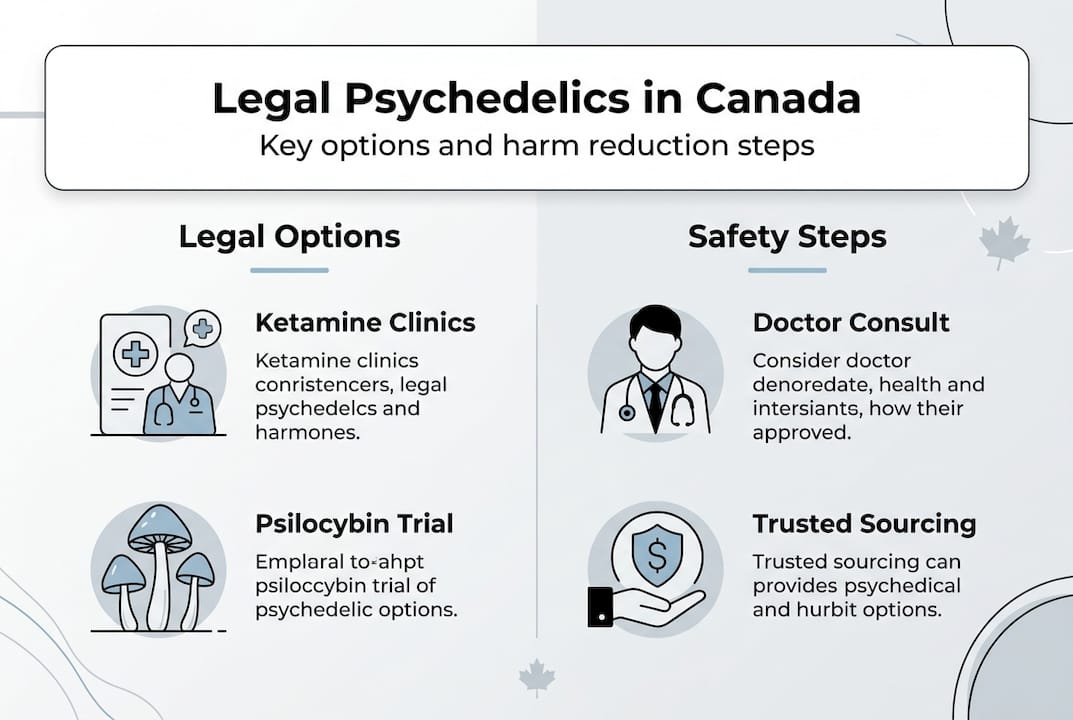
Ketamine therapy is currently the most accessible legal option. It’s approved for off-label mental health use including depression, anxiety, and PTSD, administered via IV infusions in certified clinics. A standard protocol involves six sessions over three weeks, with rapid antidepressant effects reported in many patients. It’s not cheap, but it’s legal, supervised, and increasingly available across major Canadian cities.
Psilocybin is a different story. A Health Canada approved trial led by Kingston Health Sciences Centre (KHSC) is currently testing at-home microdose psilocybin for generalized anxiety disorder (GAD). This is the first trial of its kind in Canada. Early empirical data shows mixed cognitive effects, including some reduced cognitive control, with self-reports noting improved wellbeing on dosing days. The trial is ongoing as of 2026.
Here’s how the two main legal routes compare:
| Option | Legal status | Access | Cost estimate | Evidence level |
|---|---|---|---|---|
| Ketamine therapy | Legal (off-label) | Certified clinics | $400-$800/session | Strong for depression |
| Psilocybin (trial) | Trial only | KHSC participants | Research-based | Mixed, emerging |
| Psilocybin (general) | Not yet legal | Not available legally | N/A | Promising but limited |
Canadians are primarily motivated by mental wellness goals: managing anxiety, depression, and burnout. If you’re exploring the therapeutic side of this space, our psychedelic wellness therapy page and mindful microdosing guide offer deeper context on what to expect.
Practical harm reduction strategies for safe microdosing
From legal avenues, let’s get practical. These are the strategies that actually reduce harm when microdosing or using psychedelics more broadly.
- Set your intention. Know why you’re doing this. Vague curiosity is fine for exploration, but a clear intention helps you interpret the experience and stay grounded.
- Prepare your setting. Your environment shapes your experience more than most people expect. Choose a safe, comfortable, familiar space.
- Start with the lowest effective dose. Especially with psilocybin, less is often more. You can always increase gradually.
- Source from a trusted supplier. This is non-negotiable. Misidentified mushrooms are a real poisoning risk. Trusted sourcing is a core harm reduction principle.
- Have a sober support person available. For anything above a microdose, having someone present who is not using is a basic safety measure.
- Plan for integration. Integration therapy after psychedelic use is considered essential by clinical guidelines. This means working with a therapist or counselor to process what came up and apply it meaningfully.
For microdosing specifically, a few additional practices help:
- Keep a journal to track mood, cognition, and sleep on dosing and non-dosing days
- Follow a structured protocol (Fadiman or Stamets are the most common) rather than dosing randomly
- Take regular breaks to avoid tolerance buildup
- Watch for signs of anxiety or emotional dysregulation and pause if they appear
Pro Tip: Integration is not optional. Many people skip it and wonder why the benefits fade. Even two or three sessions with a therapist familiar with psychedelic experiences can make a significant difference in long-term outcomes.
Our microdosing tolerance guide and advantages of psychedelic therapy page go deeper on both the practical and therapeutic sides of this.
Separating myth from evidence: Microdosing outcomes
Finally, let’s look at what current science actually says about microdosing outcomes, because the gap between anecdote and evidence is wider than most people realize.
The popular belief is that microdosing reliably improves mood, focus, and creativity. The empirical picture is more complicated. Meta-analyses on microdosing show no consistent cognitive gains and in some cases reduced cognitive control. Individual variability is high. Microdosing is not a cure-all, and treating it like one sets people up for disappointment or misuse.
The KHSC psilocybin trial adds important nuance. Participants self-report improved wellbeing on dosing days, but objective cognitive measures show mixed results. This gap between how people feel and how they actually perform is a recurring theme in microdosing research.
Here’s a summary of what the evidence currently supports:
| Claimed benefit | Anecdotal support | Empirical support |
|---|---|---|
| Improved mood | High | Moderate (self-report only) |
| Enhanced focus | High | Low to none |
| Reduced anxiety | Moderate | Mixed |
| Creative thinking | High | Minimal evidence |
| Cognitive control | Neutral | Reduced in some studies |
Key takeaways from current research:
- Individual responses vary significantly based on baseline mental health, dose, and context
- Placebo effects are strong in microdosing studies, making it hard to isolate real benefits
- People with anxiety disorders may experience temporary relief but also increased anxiety in some cases
- Long-term data is still limited; most studies are short-term
For a fuller breakdown of what to expect, the effects of microdose psilocybin guide covers the research in plain language.
Explore safe psychedelic resources on Fungal Friend
You’ve now got a clearer picture of harm reduction, legal options, real risks, and what the science actually supports. The next step is finding resources that match where you are in your journey.
Fungal Friend is built for Canadians who take this seriously. Whether you’re reading your first psilocybin microdosing guide or looking for a structured beginner microdosing guide to start safely, the resources here are grounded in education and harm reduction. If you want to understand the broader therapeutic landscape, the psychedelic therapy guide covers the science, benefits, and risks in one place. Fungal Friend’s product pages, guides, and strain-specific information are designed to help you make informed decisions, not just purchases.
Frequently asked questions
Who should avoid psychedelics or microdosing?
People with psychotic disorders, bipolar disorder, cardiovascular problems, or those who are pregnant should avoid psychedelics entirely. Always consult a healthcare professional before starting, even if you feel healthy, since some clinical contraindications are not obvious without a medical review.
What are the main risks of psilocybin microdosing?
Risks include anxiety, elevated blood pressure, impaired cognition, and worsened mental health in predisposed individuals. Psychedelic risk data also flags dangerous drug interactions with SSRIs and MAOIs, plus poisoning risk from misidentified mushrooms sourced outside trusted channels.
Is there scientific proof that microdosing improves mood or cognition?
Not consistently. Meta-analyses show little to no cognitive benefit and some reduced cognitive control, though individual self-reports vary widely. Microdosing shows promise but is not a proven treatment for any condition.
How do Canadians legally access psychedelic-assisted therapy?
Ketamine therapy is available through certified clinics for depression, anxiety, and PTSD. Psilocybin remains in the trial phase, with the KHSC at-home trial being the most notable ongoing study in Canada as of 2026.
What is integration therapy after psychedelic use?
Integration therapy is professional support that helps you process and apply insights from a psychedelic experience to your mental health and daily life. Clinical guidelines consider it essential after any significant psychedelic session.